The Crypto Turn: How World Liberty Financial Rewired Trump's Fortune
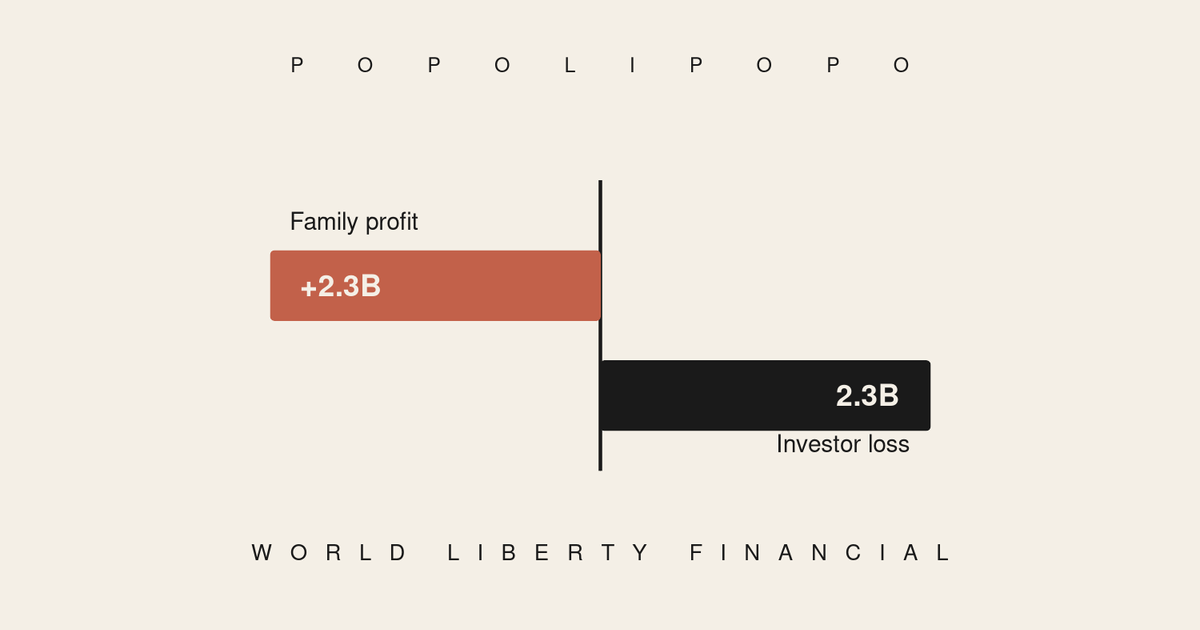
World Liberty Financial, USD1, and the TRUMP memecoin turned crypto into the most contested part of Trump's fortune. The key is separating family revenue from personal net worth.
Donald Trump's 2026 fortune no longer turns mainly on towers, golf courses, licensing deals, or Mar-a-Lago. The fastest-moving asset in the story is crypto, and the cleanest way to understand it is the symmetry Reuters reported in June.
Reuters found that the Trump family made about 2.3 billion dollars from four crypto ventures as of the end of April 2026, while putting up little to no capital of their own. In the same projects, outside investors lost roughly 2.3 billion dollars. The near-perfect symmetry is the whole story in one line. This was not a rising tide that lifted everyone. It was a transfer, and the accounting landed almost exactly even.
This is the machine behind those numbers, and the reason Forbes and Bloomberg can look at the same crypto empire and still disagree on what it is worth, a disagreement that drives most of the gap explored in the overview of Trump's 2026 net worth.
The four-venture pattern
The Reuters count spans four businesses: World Liberty Financial, the TRUMP memecoin, American Bitcoin, and a venture reported as AI Financial. They differ in the details but share a design principle. The Trump-linked entities take a large, contractually fixed share of the money that comes in, while the capital and the downside risk sit mostly with outside buyers.
World Liberty Financial is the anchor. It raised about 1.4 billion dollars by selling 30 billion of its governance tokens, and under the family's arrangement the Trumps are entitled to 75 percent of token-sale proceeds. Reuters traces roughly 987 million dollars to Trump-linked entities from disclosed sales alone, including a single 538 million dollar tranche sold to a firm called ALT5 Sigma. That is the difference between owning a business and owning a claim on its cash: the family did not need to fund World Liberty, only to hold the right to most of what it collected.
The TRUMP memecoin is the purest version of the pattern. The project has not disclosed its revenue, but blockchain data analyzed by Reuters points to about 1.2 billion dollars in total revenue, with roughly 616 million going to the family. The token peaked at 75.35 dollars in January 2025 and then fell hard. By April 2026 the people who had bought it were down more than 700 million dollars collectively. The revenue and the losses are two views of the same coins changing hands.
World Liberty's own governance token tells a similar story from the holder's side. Reuters estimates its buyers face roughly 674 million dollars in losses, worsened by the fact that early buyers cannot sell about 80 percent of their holdings, which are locked. That lockup is also why the headline "on paper" value of the family's token stake is so unreliable, a point central to the valuation fight below.
The stablecoin is the serious business
If the memecoin is the flashiest venture, the stablecoin is the one professional analysts take most seriously. It is also where the largest outside money has moved.
USD1 is World Liberty Financial's dollar-pegged stablecoin, backed by cash and short-term US Treasuries, each token meant to be redeemable for a dollar. Unlike a memecoin, a stablecoin is a plumbing business: it earns on the reserves that back the coins in circulation, the same model that made established issuers valuable. USD1 grew fast, from a market capitalization around 130 million dollars to more than 2 billion in a matter of weeks.
Most of that growth traces to a single relationship. MGX, a state-backed Abu Dhabi fund, chose USD1 to settle a 2 billion dollar investment into the exchange Binance, and Binance has at times held the large majority of all USD1 in existence, by some reporting close to 87 percent. That concentration cuts both ways. It makes USD1 large enough to matter to Trump's net worth, and it also makes it fragile: a business whose float is dominated by one counterparty is not the same as one with millions of independent users. The foreign-capital dimension of that deal, and the conflict questions it raises for a sitting president, are the subject of a separate piece on how the president's businesses get paid.
Why 2.3 billion and 550 million are both right
This is where readers get whiplash. Reuters attributes about 2.3 billion dollars to the family across these ventures. Forbes, valuing Trump for its billionaires list, credited him with netting an estimated 550 million dollars from crypto over the year. Both figures come from careful reporting. They are not in conflict, because they answer different questions.
Reuters is counting the family, across four ventures, and including revenue the Trump entities are contractually entitled to, whether or not it has all landed in a personal account. Forbes is counting Trump personally, more conservatively, leaning on gains that have plainly been realized and discounting what is locked, illiquid, or still theoretical. The 2.3 billion is the gross force of the machine. The 550 million is the slice Forbes is willing to bank into one man's net worth today. The truth of the crypto turn is not one number or the other. It is the distance between them, which measures how much of this wealth is real but diffuse, rather than banked and personal.
Trump's own 2025 financial disclosure, filed in mid-2026, reported more than a billion dollars of income tied to the crypto ventures, which sits between the two framings and confirms the order of magnitude even on the conservative end.
The valuation fight in one asset
Forbes and Bloomberg diverge mostly because they treat World Liberty differently.
Bloomberg models the operation as a going business and puts real weight on the USD1 stablecoin, valuing it against the circulation-to-market-cap ratios of established issuers. That approach can add a large private-asset line. Forbes looks at the same governance tokens, notes that most of the family's stake is locked and that the token market is thin and falling, and discounts the paper value steeply. One tracker sees a fast-growing financial business; the other sees an illiquid holding whose quoted value cannot be cashed. Neither is wrong about the facts. They are pricing the same uncertainty differently, and that single choice is worth more than a billion dollars in the top-line figure.
What the symmetry means
Step back from the mechanics and the Reuters symmetry is the thing to keep. In a normal successful venture, founders and outside investors tend to win or lose together. Here, the family's gains and the investors' losses landed at almost the same number, because these were structured as sales into a market, not shared bets on a business. The family sold tokens; the buyers held the downside.
That structure is legal, and crypto is full of projects with similar shapes. But it changes how to read every crypto line in Trump's net worth. The money that reached the family is largely real. The value still sitting in locked tokens and a one-customer stablecoin is the volatile, contested part, and it is exactly the part that makes any single figure for his fortune an estimate rather than a fact. For the assets that do not move this fast, the towers, the resorts, and the debts, see the balance-sheet breakdown.
> This article is independent editorial analysis, not financial, investment, or legal advice, and nothing here is a recommendation to buy or sell any token or security. Crypto profit and loss figures are estimates from investigative reporting and on-chain analysis, not audited accounts, and token values change constantly. Sources are listed below.
Sources and Method
This article uses only the source material listed below. The Reuters investigation is cited through CryptoSlate's summary until the original Reuters URL is confirmed and swapped in.
- Reuters investigation, "Parsing Trump's crypto profits and investors' losses" (June 9, 2026), as reported by CryptoSlate, "Trump family's 2.3B crypto windfall matched by 2.25B in investor losses, Reuters finds." Used for the family profit of about 2.3 billion across four ventures, the roughly equal investor-loss framing, the World Liberty Financial token-sale mechanics, the TRUMP memecoin revenue estimate, and the holder-loss and lockup figures. <https://cryptoslate.com/trump-familys-2-3b-crypto-windfall-matched-by-2-25b-in-investor-losses-reuters-finds/>
- Time, "Trump Reports Over 1 Billion in Income From Crypto Ventures" (July 1, 2026). Used for Trump's 2025 financial disclosure reporting more than a billion dollars of income tied to crypto ventures. <https://time.com/article/2026/07/01/trump-2025-financial-disclosure-crypto-world-liberty-financial/>
- The Block, "Trump-tied World Liberty Financial's USD1 stablecoin market cap surges from 130M to over 2B since late April." Used for the growth of USD1 from about 130 million to more than 2 billion dollars in weeks. <https://www.theblock.co/post/353618/trump-tied-world-liberty-financials-usd1-stablecoin-market-cap-surges-from-130m-to-over-2b-since-late-april>
- Forbes, "MGX Cites Compliance History In Picking Brand New Trump-Linked Stablecoin USD1 For 2 Billion Binance Deal" (October 2, 2025). Used for MGX settling a 2 billion dollar Binance investment in USD1. <https://www.forbes.com/sites/zacheverson/2025/10/02/mgx-usd1-binance-trump-stablecoin-world-liberty-financial/>
- Forbes, "Trump's Stablecoin USD1: Binance Holds 87 Percent After Founder's Pardon" (February 9, 2026). Used for Binance holding the large majority of USD1 in circulation. <https://www.forbes.com/sites/zacheverson/2026/02/09/trump-stablecoin-usd1-binance-holds-87-percent/>
- Forbes, "Here's How Much Donald Trump Is Worth" (March 10, 2026). Used for Forbes crediting Trump personally with an estimated 550 million dollars netted from crypto token sales over the year, distinct from the family-wide Reuters count. <https://www.forbes.com/sites/luisakroll/2026/03/10/heres-how-much-donald-trump-is-worth/>
- Bloomberg, Billionaires Index methodology. Used for the valuation-methodology contrast with Forbes. <https://www.bloomberg.com/billionaires/>