Why Paris Coffee Shops Became a Daily Ritual
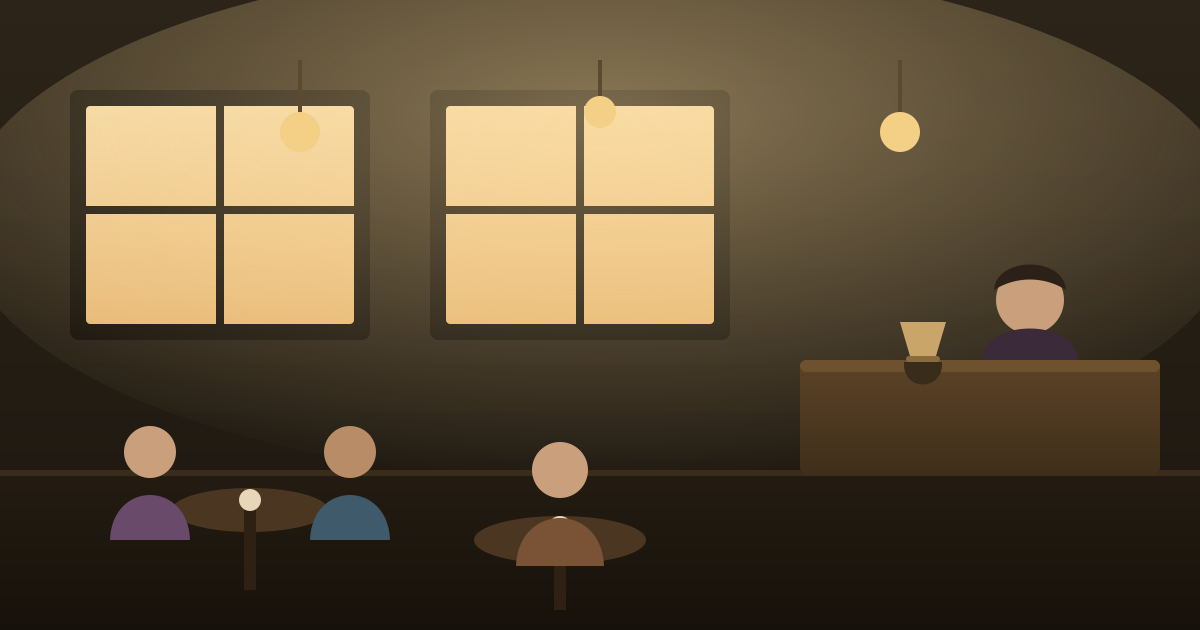
Why are coffee shops popular in Paris? Specialty coffee matters, but the stronger product is a repeatable public routine between home and work.
Paris coffee shops are popular because they sell a repeatable public routine, not simply a better cup. Coffee gets you through the door. The setting gives the day shape.
That is the useful way to read the city's specialty coffee growth. This is an analysis of the format, not a directory or a claim about the exact number of venues in Paris. The evidence supports a rise in specialty coffee and new cafe concepts. It does not support every grand theory attached to them.
What changed in Paris coffee culture?
The familiar three-wave model describes a shift from mass-market coffee, to the branded cafe experience, then to specialty coffee built around origin, preparation, and product knowledge. It is a rough commercial history, not a law of nature. A 2018 study of the specialty coffee value chain uses the framework to show how coffee moved from a commodity toward a more differentiated product and consumption experience.
Paris did not need coffee shops to invent public cafe life. It already had a deep cafe tradition. The newer format adds different signals: visible brewing technique, named origins, lighter design, takeaway service, and a closer link between the room and the brand.
The change is visible in recent reporting. In 2024, Le Monde described rapid growth among French "neo-cafes" and reported operators treating their interiors as places for sociability as well as passing trade. Its coverage of Paris roasters also documented specialty coffee moving into more addresses across the capital and its suburbs.
Better coffee is part of the explanation. It is not the deciding variable.
Why do people keep returning?
Frequency changes the economics and the meaning of the visit. A restaurant might be reserved for an occasion. A coffee shop can fit between two ordinary tasks, at roughly the same time, several days a week.
That repetition creates value. The customer knows where to order, what the room sounds like, how long the drink will take, and what kind of contact is expected. The transaction has boundaries, which makes it easy to repeat.
Research on coffee shops as urban "third places" supports the social part of this reading. Jennifer Ferreira, Carlos Ferreira, and Elizabeth Bos describe coffee shops as spaces apart from home and work where people can meet, relax, and form connections. Their study also makes an important point: the role of a coffee shop depends on its location and operation. A room does not become community infrastructure because it contains an espresso machine.
Does the coffee shop environment help people work?
Sometimes, but the popular claim is broader than the evidence.
A 2012 Journal of Consumer Research paper found that moderate ambient noise improved performance on creative tasks compared with low noise in five experiments, while high noise reduced it. The study tested sound levels and cognition. It did not prove that every coffee shop makes every laptop user more creative.
The practical mechanism is simpler. A coffee shop can offer movement and background activity without requiring the customer to participate. For some people, that is more useful than the silence of home and less demanding than an office. For others, the same room is distracting. The format works because customers can choose the setting, duration, and degree of contact.
Why does the visit feel like a ritual?
A ritual is a sequence that becomes meaningful through repetition. The coffee shop has one built in: enter, queue, order, watch the preparation, take the cup, occupy a familiar kind of space, then leave.
Specialty coffee makes that sequence more legible. Grinding, weighing, pouring, and serving happen in view of the customer. The equipment and language signal care before the drink is tasted. None of this guarantees quality, but it makes the process visible.
The customer supplies the rest. The same order before work, the same table after lunch, or the same stop on a weekend walk can mark a transition in the day. The purchase is small enough to repeat, and the sequence is stable enough to remember.
This is where "ritual economy" becomes a useful term. It describes businesses whose value depends partly on hosting a repeatable sequence. The coffee is the paid object. The routine is what supports return visits.
Why is Paris a useful case?
Paris puts the old cafe and the specialty coffee shop next to each other. The older institution centres on its own codes, menu, terrace, and social history. The newer coffee shop often foregrounds beans, barista technique, interior design, and portable consumption. In practice, the categories overlap.
That overlap matters more than a claim that Paris is unique. Recent Paris coverage shows specialty roasters opening multiple sites, operators importing coffee cultures from elsewhere, and businesses using the room itself to distinguish the offer. The city lets us watch a mature cafe culture absorb a newer retail language without replacing what came before.
The limit is equally clear. Published reporting can document openings, concepts, and operator intent. It cannot tell us that every customer is seeking identity, belonging, or relief from loneliness. Those are plausible interpretations, not measured facts in the source set.
What are coffee shops actually selling?
They sell coffee first. If the drink, service, price, or location fails, atmosphere will not rescue the business for long.
But the durable offer is larger than the beverage. A successful coffee shop packages a drink with time, place, and a predictable level of social contact. Paris makes that package easy to see because the new specialty format sits inside an older culture of public cafe use.
Use one test when assessing the next coffee concept: ask what repeated behaviour the room makes easier. If the answer is only "buy a cup," the format is thin. If the room gives a customer a reliable way to begin, pause, or reset the day, the ritual is the product.
This article is independent analysis by House of Agile. It interprets published research and reporting on coffee shops, urban social space, and specialty coffee. It does not claim a complete count of Paris venues or measure the motives of every customer.
Sources and method
- Ferreira, Ferreira, and Bos, Geoforum, research on coffee shops as urban third places and their role in social connection. https://doi.org/10.1016/j.geoforum.2020.12.024
- Mehta, Zhu, and Cheema, Journal of Consumer Research, five experiments on ambient noise and creative cognition, including the limits of high noise. https://doi.org/10.1086/665048
- Guimaraes, de Castro Junior, and de Andrade, Revista de Administracao de Empresas, analysis of value creation and the three-wave framework in specialty coffee. https://www.redalyc.org/journal/1551/155158452006/html/
- Le Monde, reporting on the growth, design, and social positioning of neo-cafes in France, with Paris examples. https://www.lemonde.fr/economie/article/2024/11/03/les-neocafes-connaissent-un-essor-sans-precedent_6373936_3234.html
- Le Monde, reporting on specialty roasters and the development of specialty coffee in Paris and Ile-de-France. https://www.lemonde.fr/m-styles/article/2024/05/17/filtre-ou-piston-cinq-torrefacteurs-pour-trouver-du-bon-cafe-a-paris-et-en-ile-de-france_6233860_4497319.html
Method
This article is an interpretive analysis, not a venue census or a consumer survey. It separates documented changes in specialty coffee and coffee-shop use from the author's explanation of why a repeatable cafe visit can acquire ritual value.
Claims not supported by this source set were removed. The article does not state a citywide Paris coffee-shop count, compare coffee shops with bakeries, estimate the home-espresso market, or name brand-cafe examples.