Green Tea and Health: What the Evidence Actually Says
What meta-analyses, Cochrane reviews and large Japanese cohorts show about green tea and weight loss, heart health, cancer, dementia and longevity, and who should limit it.
Few drinks carry as many promises as green tea. Depending on the label, it burns fat, prevents cancer, protects the brain and adds years to your life. Those claims usually trace back to a lab experiment, a single small trial, or a population study in Japan, stretched far beyond what it showed.
So we went to the strongest evidence available as of October 2026: systematic reviews, meta-analyses, the Cochrane review, and the large Japanese cohort studies that follow tens of thousands of people for years. The honest picture is narrower and more useful than the marketing. Green tea is a low-calorie caffeinated drink with a few small, measurable effects. The one serious safety signal sits not in the cup but in concentrated extract pills.
This is part three of our green tea series, after the guide to green tea types and how to brew it without bitterness.
What is actually in a cup
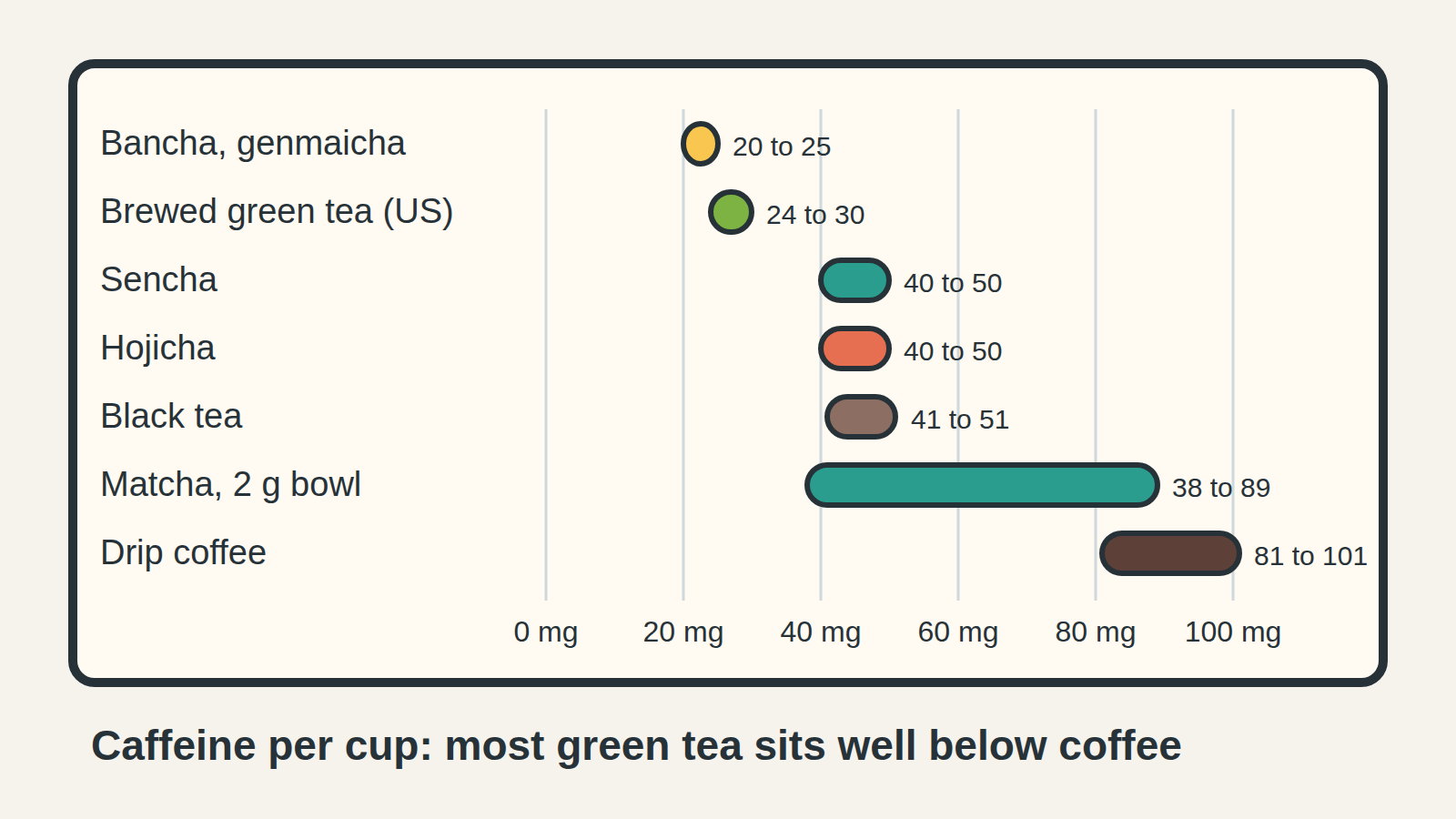
Caffeine varies more than tenfold depending on the tea and how it is brewed. Japan's official food composition tables, which state the brewing method behind each number, give these figures for a 200 to 250 ml cup:
- Sencha: about 40 to 50 mg.
- Bancha and genmaicha: about 20 to 25 mg.
- Hojicha: about 40 to 50 mg. Despite its reputation, roasted tea is not caffeine-free.
- Gyokuro: about 96 mg in a traditional 60 ml serving. Gyokuro is brewed extremely concentrated, so a full mug at that strength would hold several times more.
- Matcha: about 38 to 89 mg in a 2 g bowl, because you swallow the whole leaf.
- Ordinary brewed green tea, by the US reference figure: about 24 to 30 mg per cup. Black tea is around 41 to 51 mg and drip coffee around 81 to 101 mg.
L-theanine, the amino acid often credited with green tea's "calm alertness", is less plentiful in a cup than its reputation suggests. A study of commercial teas brewed the standard way found about 8 mg in a 200 ml cup of green tea, less than the 24 mg in black tea. Matcha is the exception: one assayed serving of about 2 g contained 48 mg, because you swallow the leaf.
Keep serving size in mind when you read the studies below. The Japanese cohorts count cups as participants reported them, not in standard mugs, so "five cups a day" is a habit, not a precise dose.
What holds up
Attention, briefly. A 2025 review in Nutrition Reviews looked at 49 trials of tea, L-theanine and caffeine; 16 of them, with 484 participants, could be pooled. Caffeine and L-theanine taken together improved some attention measures, such as accuracy when switching between tasks, for one to two hours. Effects on overall alertness and mood were uncertain. The caveats are large. The median dose in the combination trials (82 mg of L-theanine plus 89 mg of caffeine) holds far more theanine than a cup of green tea, 11 of the 16 pooled trials tested isolated compounds rather than tea, and none of the trials was judged at low risk of bias. Industry funded eight of them, and the review itself was funded through a Lipton Teas and Infusions PhD studentship, with authors employed by Lipton and Unilever.
Cholesterol, a little. A 2020 meta-analysis of 31 randomised trials found green tea lowered LDL cholesterol by about 4.6 mg/dL on average, with no convincing effect on HDL or triglycerides. Many of those trials used extracts.
Blood pressure, a little. A 2025 review of 36 trials found average drops of about 1 mmHg in both systolic and diastolic pressure, with results varying widely between studies.
Those cardiovascular changes might matter slightly across a whole population. They are far too small to replace medication for anyone who needs it.
What is associated, but not proven
The headline-grabbing results come from observational studies, which can show that tea drinkers fare better but cannot show that tea is the reason.
Longevity. In Japan's Ohsaki study of 40,530 adults, drinking five or more cups a day, compared with less than one, was linked to 12% lower mortality in men and 23% lower in women, driven mainly by heart disease and stroke; cancer deaths were not lower. A 2019 pooled analysis of eight Japanese cohorts, 313,381 people followed for an average of 17 years, found the same pattern: at five or more cups a day, all-cause mortality was 10% lower in men and 18% lower in women, with lower deaths from heart disease and stroke.
Heart disease and stroke. A review of 39 cohort studies found each extra cup of tea a day was linked to about 4% lower cardiovascular mortality and 4% lower stroke risk. That review combined green and black tea, so it is not specific to green tea.
Dementia. Among 13,645 Japanese adults aged 65 and over, five or more cups a day was associated with 27% lower risk of developing dementia over 5.7 years. Smaller studies are mixed, and almost all the green tea specific evidence comes from Japan.
Diabetes. Some Asian cohorts report lower incidence among heavy drinkers: in one Japanese study of 17,413 adults, six or more cups a day was linked to about a third lower risk of self-reported diabetes. Trials, however, show at most a tiny drop in fasting glucose and no consistent improvement in long-term blood sugar.
Why the caution? Green tea drinking in Japan tracks a whole traditional way of eating and living. Smoking, alcohol, diet, exercise, income, education and existing illness all differ between heavy and light drinkers, and people often stop drinking tea when they become ill. Statistical adjustment reduces these biases but cannot remove them. The fair wording is "associated with lower mortality", not "extends life".
What does not hold up
Weight loss. A 2020 meta-analysis of 26 trials found green tea supplements reduced weight by about 1.8 kg on average, with no consistent change in waist size. Most trials used capsules or extracts, often alongside diet or exercise. That is well below the roughly 5% of body weight usually considered clinically meaningful. Green tea is not a weight-loss treatment.
Cancer prevention. The 2020 Cochrane review covered 142 studies, including observational data on more than 1.1 million people. Results were inconsistent across cancer types, most evidence was rated low or very low certainty, and the authors could not recommend green tea for cancer prevention. Back in 2005, the US FDA allowed only a deliberately sceptical label claim for breast and prostate cancer, stating that it was "highly unlikely" green tea reduced risk.
Oral health. Small trials suggest green tea extract mouthwashes may reduce plaque over a few weeks. That says nothing about drinking tea.
European regulators agree. EFSA, the EU's food safety authority, has declined to approve health claims for green tea on weight control, blood glucose, blood pressure, cholesterol and antioxidant protection, and for L-theanine on cognition, stress and sleep, because cause and effect was not established.
The real risk is in capsules
Brewed green tea and concentrated extracts are not the same thing, and the safety evidence treats them differently.
EFSA concluded in 2018 that green tea as a traditional drink is generally safe. It also found that supplements delivering 800 mg or more of EGCG a day raised liver enzymes in trials, and it could not identify a supplement dose guaranteed to be risk-free. A capsule delivers a concentrated dose, sometimes on an empty stomach, which is not the same as the same amount spread through several cups of tea.
The EU acted on that. Since Regulation (EU) 2022/2340, foods containing green tea extract must provide less than 800 mg of EGCG per daily portion, and their labels must warn against taking them on an empty stomach, combining them with other green tea products the same day, or using them while pregnant, breastfeeding or under 18. In the US, the NIH's LiverTox database calls green tea extract a well-established cause of clinically apparent liver injury, with more than 100 reported cases, mostly from tablets and capsules. The US Pharmacopeia now requires its extract monograph to carry a warning to take it with food and to stop if you develop abdominal pain, dark urine or yellowing skin.
Who should be careful
- Pregnancy and breastfeeding. EFSA's limit is 200 mg of caffeine a day from all sources (400 mg for other healthy adults). That is roughly four to five cups of sencha before counting coffee, cola or chocolate. Avoid extract supplements, and take a folic acid supplement with water rather than tea: a Japanese study of 254 pregnant women linked high green or oolong tea intake to lower blood folate.
- Iron deficiency. Tea reduces absorption of iron from plants and iron tablets. In one controlled trial, absorption from a meal fell from 5.7% with water to 3.6% with tea, and waiting an hour roughly halved the effect. Keep tea at least an hour away from meals and iron pills.
- Nadolol. In a trial, drinking green tea for two weeks cut blood levels of this beta blocker by about 85%. That finding applies to nadolol specifically, not to every beta blocker.
- Warfarin. One case report linked a large drop in clotting control to drinking half a gallon to a gallon of green tea a day; it recovered when the patient stopped. Moderate, consistent intake is the point; do not suddenly start or stop drinking a lot.
- Bortezomib (a cancer drug). EGCG blocked it in lab and animal studies. Human evidence is lacking, but the stakes are high enough to avoid extracts and talk to the oncology team.
A note on matcha
Because you swallow the leaf, matcha carries whatever the leaf carries. In July 2026 the EU's food safety alert system flagged a Chinese matcha with about 1,900 mg/kg of aluminium, roughly 3.8 mg in a 2 g serving, judged unsafe and withdrawn from the market. In July 2025 a Japanese matcha was sent back after tests found residues of several pesticides, including one not authorised in the EU. Contamination is a batch problem, not a national one, so daily matcha drinkers should favour suppliers that publish recent lab results for each lot. Our green tea gear guide covers what to check on a matcha label and what it costs in 2026.
Radiation is not a current concern. The EU lifted its last post-Fukushima import restrictions on Japanese food in August 2023, and in Japan's 2022 monitoring all 228 tested samples of tea, drinking water and beverages were within limits.
The bottom line
Drink green tea because you like it. It is a pleasant, low-calorie source of moderate caffeine that may give a small, short boost to attention and slightly nudge cholesterol and blood pressure. It is not a proven treatment for obesity, diabetes, cancer or dementia. And if you are tempted by green tea pills, know that concentrated extracts carry a liver risk that the tea in your cup does not.
This article is independent analysis by House of Agile, based on published systematic reviews, cohort studies and regulatory opinions. It is not medical advice. If you are pregnant, take medication or have a liver condition, talk to a doctor or pharmacist before changing your intake or taking supplements.
Sources
Caffeine and theanine content
- Japan Ministry of Education (MEXT), Standard Tables of Food Composition, gyokuro infusion entry. fooddb.mext.go.jp
- MEXT, Standard Tables of Food Composition, hojicha infusion entry. fooddb.mext.go.jp
- MEXT, Standard Tables of Food Composition, genmaicha infusion entry. fooddb.mext.go.jp
- MEXT, Standard Tables of Food Composition 2015, beverages chapter (bancha). https://www.mext.go.jp/component/a_menu/science/detail/__icsFiles/afieldfile/2017/02/16/1365343_1-0216r9.pdf
- Japan Ministry of Agriculture, Forestry and Fisheries (MAFF), caffeine in foods and beverages, November 2021. https://www.maff.go.jp/j/syouan/seisaku/risk_analysis/priority/hazard_chem/caffeine.html
- Molecules, review of matcha composition including caffeine range, December 2020. https://pmc.ncbi.nlm.nih.gov/articles/PMC7796401/
- Nutrients, matcha trial with assayed caffeine and L-theanine per serving, May 2021. https://pmc.ncbi.nlm.nih.gov/articles/PMC8156288/
- International Food Information Council, caffeine calculator based on USDA FoodData Central. https://ific.org/resources/caffeine-calculator/
- Keenan et al., Food Chemistry, how much theanine in a cup of tea, 2011. https://doi.org/10.1016/j.foodchem.2010.08.071
Systematic reviews and meta-analyses
- Payne et al., Nutrition Reviews, caffeine and L-theanine on cognition and mood, 2025. https://doi.org/10.1093/nutrit/nuaf054
- Lin et al., Phytotherapy Research, green tea supplementation and body weight, 2020. https://doi.org/10.1002/ptr.6697
- Xu et al., Nutrition Journal, green tea and blood lipids, 2020. https://doi.org/10.1186/s12937-020-00557-5
- Rezaei et al., Blood Pressure, green tea supplementation and blood pressure, GRADE-assessed meta-analysis, 2025. https://doi.org/10.1080/08037051.2025.2517122
- Chung et al., Advances in Nutrition, tea consumption and cardiovascular disease dose-response, 2020. https://doi.org/10.1093/advances/nmaa010
- Liu et al., American Journal of Clinical Nutrition, green tea and glucose control, 2013. https://doi.org/10.3945/ajcn.112.052746
- Filippini et al., Cochrane Database of Systematic Reviews, green tea for the prevention of cancer, 2020. https://doi.org/10.1002/14651858.CD005004.pub3
- Quan et al., Critical Reviews in Food Science and Nutrition, tea and cognitive decline, 2024. https://pubmed.ncbi.nlm.nih.gov/36579429/
- Cai et al., Evidence-Based Complementary and Alternative Medicine, herbal mouthwashes for plaque and gingivitis, 2020. https://doi.org/10.1155/2020/2829854
Cohort studies
- Kuriyama et al., JAMA, green tea and mortality in the Ohsaki cohort, 2006. https://doi.org/10.1001/jama.296.10.1255
- Abe et al., European Journal of Epidemiology, green tea and mortality, pooled analysis of eight Japanese cohorts, 2019. https://doi.org/10.1007/s10654-019-00545-y
- Tomata et al., American Journal of Geriatric Psychiatry, green tea and incident dementia (Ohsaki Cohort 2006), 2016. https://doi.org/10.1016/j.jagp.2016.07.009
- Iso et al., Annals of Internal Medicine, green tea and type 2 diabetes in Japan, 2006. https://doi.org/10.7326/0003-4819-144-8-200604180-00005
Regulators and safety
- European Food Safety Authority, scientific opinion on the safety of green tea catechins, 2018. https://www.efsa.europa.eu/en/efsajournal/pub/5239
- European Commission, Regulation (EU) 2022/2340 restricting green tea extracts. https://eur-lex.europa.eu/eli/reg/2022/2340/oj/eng
- EFSA, scientific opinion on green tea health claims, 2010. https://doi.org/10.2903/j.efsa.2010.1791
- EFSA, scientific opinion on L-theanine health claims, 2011. https://doi.org/10.2903/j.efsa.2011.2238
- EFSA, scientific opinion on the safety of caffeine, 2015. https://www.efsa.europa.eu/en/efsajournal/pub/4102
- US Food and Drug Administration, qualified health claims letters including green tea and cancer. https://www.fda.gov/food/food-labeling-nutrition/qualified-health-claims-letters-enforcement-discretion
- Memorial Sloan Kettering Cancer Center, FDA concludes green tea does not reduce the risk of certain cancers, 2005. https://www.mskcc.org/cancer-care/diagnosis-treatment/symptom-management/integrative-medicine/herbs/news-alerts/fda-concludes-green-tea-does-not-reduce-risk-certain
- US National Institutes of Health, LiverTox entry on green tea. https://www.ncbi.nlm.nih.gov/books/NBK547925/
- US Pharmacopeia safety review of green tea extracts, Toxicology Reports, 2020. https://www.sciencedirect.com/science/article/pii/S2214750019306596
- NIH National Center for Complementary and Integrative Health, green tea fact sheet. https://www.nccih.nih.gov/health/green-tea
- US National Cancer Institute, dietary interactions with cancer therapy (PDQ). https://www.cancer.gov/about-cancer/treatment/cam/hp/dietary-interactions-pdq
Interactions and absorption
- Ahmad Fuzi et al., American Journal of Clinical Nutrition, a one-hour interval between a meal and tea and iron absorption, 2017. https://doi.org/10.3945/ajcn.117.161364
- Misaka et al., Clinical Pharmacology and Therapeutics, green tea and nadolol, 2014. https://doi.org/10.1038/clpt.2013.241
- Taylor and Wilt, Annals of Pharmacotherapy, probable antagonism of warfarin by green tea, 1999. https://doi.org/10.1345/aph.18238
- Shiraishi et al., BioScience Trends, serum folate and tea consumption during pregnancy, 2010. https://pure.fujita-hu.ac.jp/en/publications/association-between-the-serum-folate-levels-and-tea-consumption-d/
Contaminants and radiation
- European Commission RASFF Window, notification 2026.5922, aluminium in matcha from China. https://webgate.ec.europa.eu/rasff-window/screen/notification/856394
- European Commission RASFF Window, notification 2025.5725, pesticide residues in matcha from Japan, July 2025. https://webgate.ec.europa.eu/rasff-window/screen/notification/779867
- Ministry of Foreign Affairs of Japan, EU lifting of import restrictions on Japanese food, 2023. https://www.mofa.go.jp/press/release/press6e_000483.html
- Ministry of Foreign Affairs of Japan, radionuclide monitoring of Japanese food. https://www.mofa.go.jp/files/100564878.pdf