How to Brew Green Tea So It Isn't Bitter
Why green tea turns bitter, the right water temperature, steep time and leaf amount for sencha, gyokuro, hojicha, Longjing and more, plus cold brew and matcha ratios.
Here is a result that surprises most tea drinkers. In a controlled study at Cornell, researchers brewed the same green tea with moderately hard tap water and with soft bottled water. The soft water pulled out roughly twice as much EGCG, the main bitter catechin in green tea. Tasters still found the tap-water tea less bitter, and liked it more.
That one finding captures the whole problem. Bitterness in green tea is not a fixed property of the leaf. It is the result of what you choose to pull out of it, and temperature, time, leaf quantity and even water chemistry all shift the balance. Get those right and an ordinary sencha tastes sweet and savoury. Get them wrong and an expensive gyokuro tastes like a mouthful of aspirin.
This is part two of our green tea series. If you are not sure which tea you have, start with the guide to green tea types.
Why green tea turns bitter
A cup of green tea draws on three groups of compounds that dissolve at different speeds.
- Amino acids, above all theanine, carry the savoury, brothy umami. They dissolve readily even in cool water and come out early. In one study at 85°C, total free amino acids rose from 211 mg per litre after 2 minutes to 277 mg after 15 minutes: most of the gain arrives in the first minutes.
- Caffeine is bitter and also extracts fairly quickly. A study of brewing conditions found caffeine already substantially extracted within about five minutes.
- Catechins, especially the "gallated" ones called EGCG and ECG, are the main source of bitterness and the drying, puckering feeling called astringency. They come out increasingly as water gets hotter and contact gets longer.
So a short, cool brew favours sweetness and umami, and a long, hot brew piles on bitterness and astringency. The two sensations are not the same: bitterness is a taste, while astringency is a tactile effect, partly caused by catechins binding to proteins in saliva. They also interact. Caffeine and EGCG intensify each other, while theanine softens the harshness of EGCG.
There is a ceiling on the benefit of heat, too. A Turkish study found the most EGCG, and the best sensory score, at 85°C for 3 minutes. Going hotter or longer did not keep adding EGCG, because the catechins start to degrade while they extract.
The brewing chart
All amounts are grams of leaf per 100 ml of water. A typical mug holds 250 to 300 ml, so multiply accordingly. These figures come mainly from Japan's agriculture ministry (MAFF), the Japan Tea Central association and Ito En's brewing guidance. Where they disagree, the range covers both.
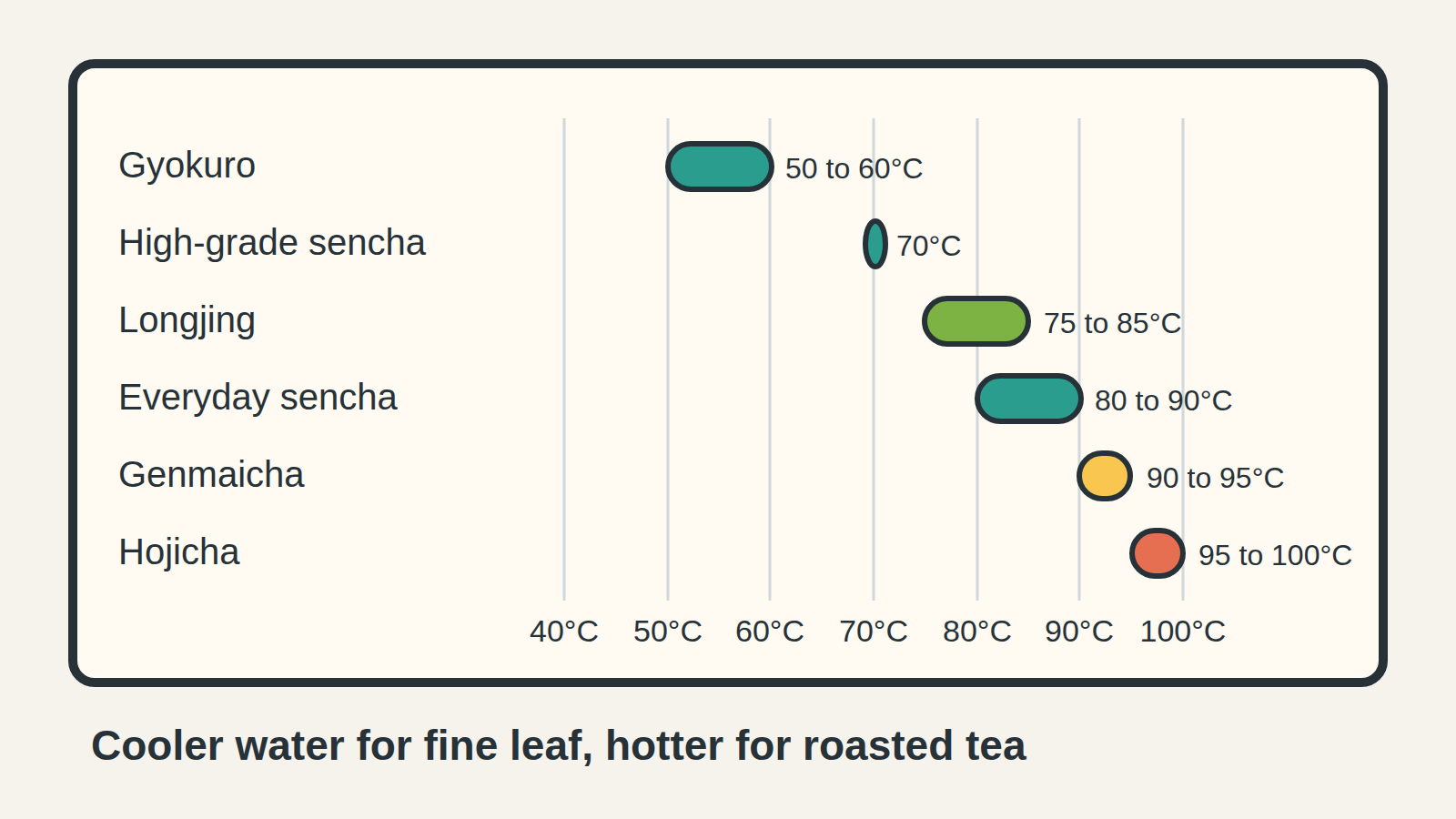
- Sencha. 2 to 3 g per 100 ml. Water at 70°C for high-grade sencha, 80 to 90°C for everyday sencha. Steep 60 to 90 seconds. Second steep slightly hotter and shorter, about 45 seconds. Two good infusions, sometimes a third.
- Fukamushi (deep-steamed) sencha. About 3.3 g per 100 ml, 70 to 80°C, only 30 seconds. The second steep is slightly hotter and about 20 seconds. Its broken leaf extracts very fast, which is why it turns harsh when treated like ordinary sencha.
- Gyokuro. 5 to 8 g per 100 ml for a practical cup, at 50 to 60°C, for 90 to 150 seconds. The traditional high-grade method is far more concentrated: 10 g of leaf in only 60 ml at 50°C for 150 seconds, served in small cups. MAFF explains the logic: cool water extracts the amino acids while holding back caffeine and the bitter catechins. Two or three infusions.
- Bancha. About 2.3 g per 100 ml, boiling water, 30 seconds. Hot and brief, because the tough mature leaf is valued for briskness and aroma, not umami.
- Hojicha. About 2.3 g per 100 ml, 95 to 100°C, 30 seconds. High heat is what releases the roasted aroma.
- Genmaicha. 2 to 2.5 g per 100 ml, 90 to 95°C, 30 to 60 seconds. There is no official recipe; this follows the bancha and hojicha method.
- Longjing. 2 to 3 g per 100 ml, 75 to 85°C, 60 to 120 seconds, two or three infusions. Ito En's general guide for Chinese loose tea is at least 80°C for 2 to 3 minutes; Longjing's tender flat leaf usually suits the lower end.
- Gunpowder. About 2 g per 100 ml, 80 to 90°C, 90 to 180 seconds. The tight pellets of sturdier leaf take more heat and time than Longjing.
If you have seen tea professionals use boiling water for six minutes, that is ISO 3103, a standard tasting method for comparing teas side by side. It is designed to expose faults consistently, not to make an enjoyable cup.
Water matters more than you think
MAFF recommends soft water for Japanese tea, below 100 mg per litre of hardness and ideally 30 to 80. Hard water can mute the fresh aroma, change the colour and leave a scum on the surface. Ito En also suggests boiling chlorinated tap water before use, and an activated-carbon filter is the more reliable fix where the supply uses chloramine.
The Cornell study complicates the simple "soft is better" rule. It brewed at 80°C for 3 minutes. Its tap water contained about 54 mg per litre of calcium (roughly 173 mg per litre of total hardness, comparable to moderately hard water in much of Europe), while the bottled water had very little. Soft and deionised water extracted about twice as much EGCG as the tap water, yet the tap-water tea tasted less bitter. Calcium appears to hold back catechin extraction and to blunt bitterness at the same time.
What that means in practice:
- For gyokuro and good sencha, use soft or filtered water. Minerals mask the delicate umami you paid for.
- For an everyday tea that keeps coming out harsh, moderately hard tap water may actually taste gentler.
- If switching to filtered water makes your tea more bitter, the answer is lower temperature or a shorter steep, not going back to hard water.
Cold brew, done properly
Cold brewing, called mizudashi in Japan, trades temperature for time. It usually gives a sweeter, rounder cup with a better balance of amino acids to catechins. It is not catechin-free and it is not decaf.
A controlled study compared sencha brewed hot (75°C for 4 minutes) with sencha cold-brewed in the fridge (4°C for 12 hours). Per gram of leaf, EGCG came out almost identical: 4.09 mg hot, 4.13 mg cold. Total phenolics were actually higher in the cold brew. Caffeine was higher in the hot brew. And a concentrate made hot and then poured over ice behaved like hot tea, not cold brew.
Two ways to do it:
- Fast: Ito En's method uses 6 g of sencha with 200 ml of very cold water and ice in a teapot for about 3 minutes.
- Fridge: 2 to 3 g per 100 ml for 2 to 6 hours. Taste after 2 hours and strain when it is right. Overnight brews are stronger, and not necessarily lower in caffeine.
For how much caffeine is in each style of cup, see what the health research actually says.
Matcha
Matcha is a suspension, not an infusion. You drink the whole powdered leaf, so cooler water changes how bitter it tastes but does not reduce the caffeine or catechins you swallow.
- Usucha (thin tea): 1.5 to 2 g of matcha with 50 to 70 ml of water at 75 to 80°C. Sift the powder, then whisk briskly into a fine foam.
- Koicha (thick tea): 3.5 to 4 g with 30 to 40 ml at about 75 to 80°C. Add the water gradually and knead slowly; do not try to make foam.
These are customary working ratios rather than fixed rules. The tea ceremony schools measure with a bamboo scoop and a ladle, not grams. Urasenke practice favours a fuller foam on usucha; Omotesenke leaves less.
Troubleshooting a bad cup
Most failures come from a short list of habits:
- Boiling water for every green tea. Save near-boiling water for bancha, hojicha and genmaicha. Cool it down for sencha, gyokuro and Longjing.
- Too little leaf, stretched with time. A long, weak steep extracts more of the harsh compounds without the body of a short, concentrated one. Add leaf before adding time.
- Leaving tea in the pot. The leaf keeps extracting and ruins the next infusion. MAFF and Ito En both say to pour out every last drop.
- Repeating the first steep unchanged. Wet leaf extracts faster. Use slightly hotter water and a much shorter second steep.
- Treating fukamushi like ordinary sencha. Start at 30 seconds, and use a pot with a fine mesh filter.
- Very hard or alkaline water for delicate teas. Try filtered or low-mineral water.
- Overnight cold brew with a lot of leaf. Slow is not zero. Taste early.
- Stale leaf. Old tea tastes flat, which tempts you to use more heat and time. Keep it airtight, dark and cool, and let refrigerated tea warm to room temperature before opening.
- Boiling water on matcha, or too much powder. You cannot strain bitterness out of a bowl. Start with 1.5 to 2 g in 60 ml at about 80°C.
When a cup is too bitter, change one thing at a time in this order: lower the temperature first, shorten the time second, and only then reduce the leaf. When a cup is flat, go the other way but start with more leaf rather than hotter water. Extra leaf adds body and umami, while extra heat mostly adds bitterness.
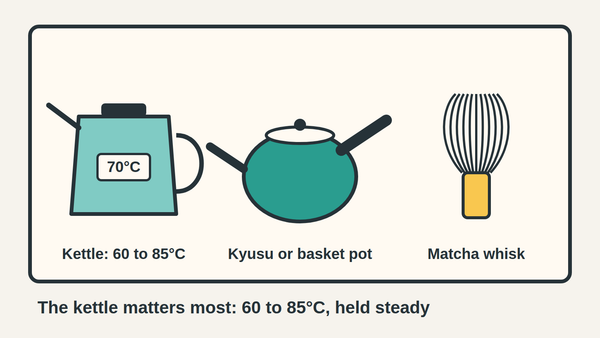
The right kettle makes the first of those adjustments easy. Our green tea gear guide covers which temperature-control kettles test accurately, and which pots suit which teas.
This article is independent analysis by House of Agile. Brewing figures come from Japan's agriculture ministry, the Japan Tea Central association, Ito En and peer-reviewed food chemistry research. Treat them as starting points and adjust to your own tea and taste.
Sources
Brewing guidance
- Japan Ministry of Agriculture, Forestry and Fisheries (MAFF), Japanese tea brewing manual (leaf ratios, temperatures, water hardness). https://www.maff.go.jp/j/seisan/tokusan/cha/attach/pdf/ocha-1.pdf
- MAFF, feature on gyokuro and low-temperature brewing, April 2022. https://www.maff.go.jp/j/pr/aff/2204/spe1_03.html
- Japan Tea Central Public Interest Incorporated Association, brewing recipes by tea type. http://www.nihon-cha.or.jp/pdf/recipe.pdf
- Ito En, how to brew Japanese and Chinese tea. https://shop.itoen.jp/japanese-tea-store/feature/howtomake/
- Ito En, brewing roasted and aromatic teas (hojicha, genmaicha). https://shop.itoen.jp/kenkotai/sozai_vol83/
- Ito En, cold-brew (mizudashi) method. https://shop.itoen.jp/kenkotai/interview_vol93
- International Organization for Standardization, ISO 3103 tea tasting method. https://www.iso.org/search.html?q=ISO%203103
Extraction chemistry
- Vuong et al., Journal of Separation Science, extraction kinetics of catechins and caffeine, 2010. https://pubmed.ncbi.nlm.nih.gov/21339166/
- Saklar et al., Journal of Food Science and Technology, brewing time and temperature effects on green tea catechins, 2015. https://doi.org/10.1007/s13197-015-1746-y
- Liu et al., Food Chemistry, optimisation of green tea brewing for sensory acceptance, 2018. https://doi.org/10.1016/j.foodchem.2018.06.130
- Horanni and Engelhardt, Food Research International, free amino acid extraction from tea, 2013. https://www.sciencedirect.com/science/article/abs/pii/S0963996912004218
- Review of bitterness and astringency compounds in tea, PMC. https://www.ncbi.nlm.nih.gov/pmc/articles/PMC8909160/
Water and cold brew
- Nutrients, effect of water type on green tea catechins and consumer acceptance (Cornell), January 2019. https://pmc.ncbi.nlm.nih.gov/articles/PMC6356489/
- Mossion et al., Food Chemistry, water composition and tea infusion chemistry, 2008. https://doi.org/10.1016/j.foodchem.2007.05.098
- Lantano et al., Journal of Food Science and Technology, hot versus cold brewed green tea, 2015. https://pmc.ncbi.nlm.nih.gov/articles/PMC4648929/