A Practical Guide to Green Tea: Sencha, Gyokuro, Matcha, Longjing and the Rest
A clear guide to the main Japanese and Chinese green teas, how each is grown and processed, what harvest words like shincha and Mingqian mean, and which label claims to ignore.
Most people meet green tea as a supermarket bag dunked in boiling water, and conclude that it tastes like wet grass with a bitter finish. Then someone pours them a cup of properly brewed gyokuro, which tastes closer to a light broth, or a Longjing that smells of toasted chestnuts, and the category stops making sense.
It makes sense once you see that "green tea" names a processing method, not a flavour. Every tea in this guide comes from the same plant, Camellia sinensis. What separates a grassy sencha from a nutty Longjing is a handful of decisions made in the field and the factory in the hours after picking. Learn those decisions and you can predict roughly how a tea will taste before you open the bag, and you can tell which words on the label carry real information.
This is the first piece in a four-part series. The others cover brewing without bitterness, what the health research actually says, and the gear and the leaf worth buying.
What makes tea "green"
Fresh tea leaves contain catechins (the main polyphenols in tea) and enzymes, including polyphenol oxidase. Left alone, and especially once the leaf is bruised or rolled, those enzymes turn the catechins into the darker compounds that give black tea its colour and malty taste.
Green tea is tea in which that reaction is stopped early. Producers heat the fresh leaf before rolling it, a step called kill-green or fixation (sha qing in Chinese, satsusei in Japanese). The heat inactivates the enzymes, so when the leaf is later rolled and broken, the browning chemistry does not run.
Two caveats are worth knowing. First, green tea is not literally "unoxidised". Fixation shuts down the main enzymatic reaction, but slower, non-enzymatic changes still happen during drying and storage, which is one reason old green tea turns dull. Second, the black tea process is often called "fermentation", which is misleading. It is enzymatic oxidation; no microbes are involved.
How the leaf is heated matters a great deal:
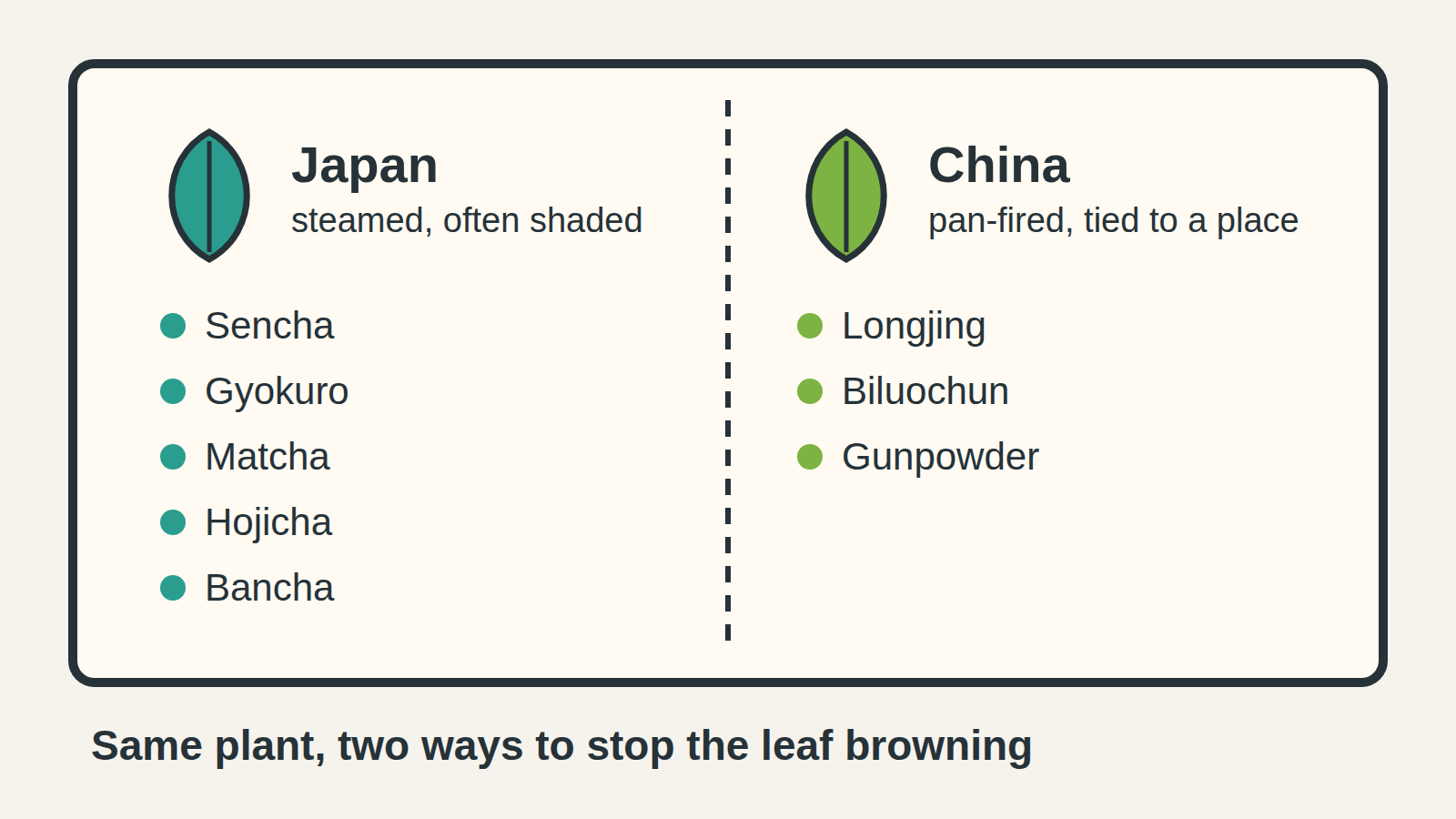
- Steaming, the Japanese norm, uses moist heat that penetrates quickly and evenly, usually within seconds. It tends to keep a vivid green colour and gives clean, vegetal, sometimes marine flavours.
- Pan-firing, the Chinese norm, presses or tosses leaves against hot metal. Shaping often happens in the same pan, as with the flat blades of Longjing. Expect more roasted, nutty, bean-like or sweet notes, and a yellow-green to olive cup.
- Bake-drying is used in some Chinese teas after a pan fixation. A 2022 study found that this final drying step could shape the flavour more than the choice of steaming or pan-firing did.
Treat "steamed equals grassy, pan-fired equals nutty" as a tendency, not a law. Controlled studies disagree on individual aroma compounds, because cultivar, firing temperature and final drying all differ from one experiment to the next.
After fixation comes rolling, which gives the leaf its needle, curl, pellet or flat shape and breaks cells so flavour can reach the water. Then drying brings moisture down far enough for storage, and builds aroma of its own.
Japanese green teas: steamed, and often shaded
The most useful definitions come from the Japan Tea Central association's green tea labelling standard, an industry-wide rulebook last revised in March 2019. It works alongside Japanese food-labelling law; it is not a government ranking of quality. The flavour notes below are typical, not guaranteed.
- Sencha. The everyday tea of Japan. Usually grown in open fields, then steamed, rolled and dried. Fresh and vegetal, with moderate umami and some briskness.
- Fukamushi sencha ("deep-steamed"). Made like sencha but steamed at least twice as long. The leaf breaks into small pieces, so the cup is cloudy, deep green, fuller and softer.
- Gyokuro. The first-flush shoots are covered for about 20 days, with sunlight almost completely blocked, then processed like sencha. Concentrated umami and sweetness, a seaweed-like aroma, little astringency.
- Kabusecha. Covered for about seven days just before harvest. It sits between sencha and gyokuro.
- Tencha and matcha. Tencha leaf is shaded for about two to three weeks, steamed, then dried flat without rolling, and its stems and veins are removed. Matcha is tencha ground to a fine powder. Because you drink the whole leaf, matcha combines strong umami and green aroma with variable bitterness.
- Bancha. Made from mature or hardened leaf, older leaves and stems, or leaf picked between the main harvests. Milder and woodier, with less umami.
- Hojicha. Finished green tea (sencha, bancha or stems) roasted over strong heat. The cup is brown and tastes of toasted grain, nuts and caramel, with almost none of the original grassiness.
- Genmaicha. Sencha or bancha blended with roasted rice, so the cup is part cereal and part tea.
- Kukicha (also bocha). Stem tea, separated during finishing. Light and sweet with little astringency. Stems from shaded gyokuro or tencha are sometimes sold as karigane.
Why does shade matter so much? Japanese field trials found that covering the bushes raises chlorophyll and theanine, the amino acid most associated with tea's savoury, brothy taste, while lowering some of the catechins that make tea astringent. In trials with 75% and 90% shade for 20 days, theanine stayed higher than in unshaded shoots. That is the chemistry behind gyokuro's deep green colour and umami. The effect depends on how heavy the shade is, how long it stays on and the cultivar, so it is a direction, not a fixed recipe.
One more warning: you will see precise steaming times quoted online, such as "fukamushi is steamed for 60 to 120 seconds". The Japanese standard does not say that. It says only that fukamushi is steamed at least twice as long as ordinary sencha. Exact second counts are sellers' conventions.
Chinese green teas: pan-fired and tied to a place
Chinese green tea is overwhelmingly pan-fixed, then dried in a pan, a basket or an oven. None of the famous teas below has a traditional shading requirement like gyokuro. What they do have is geography, and several are legally protected names.
- Longjing (Dragon Well). From Zhejiang province. Spring shoots, often one bud with one or two leaves, are pan-fixed and pressed into flat, smooth blades. Fresh and sweet, with bean, nut or chestnut notes; over-firing makes it bitter. The broader Longjing geographical indication covers several production areas in Zhejiang, while West Lake (Xihu) Longjing is a much narrower protected zone around Hangzhou with its own local standard, in force since January 2024. Longjing Cha has also been registered as a protected designation of origin in the EU since 2011.
- Dongting Biluochun. From the Dongting area of Suzhou, Jiangsu. Very tender early-spring shoots, rolled into tight spirals covered in fine down. Strongly floral and fruity, with a fresh sweetness. Curly "Biluochun-style" tea is also made far outside Jiangsu.
- Huangshan Maofeng. From Huangshan City in Anhui, picked around the Qingming and Grain Rain solar terms. Kill-green, light shaping, then two rounds of baking. Clear, mellow and sweet, often with an orchid-like aroma.
- Taiping Houkui. From Huangshan District in Anhui, made from a large-leaf local variety. Picked later, as a bud with two big leaves, then pressed flat on screens and dried in stages. Mellow, sometimes savoury, with an orchid aroma that researchers treat as a mark of high grade.
- Lu'an Guapian. From Lu'an in Anhui, and unusual because it prefers mature leaves to buds. Buds and stems are removed and the leaves fired repeatedly into curled "melon seed" shapes. Full and sweet. It is one of the Chinese teas protected by name under the EU and China geographical indication agreement.
- Gunpowder. A style rather than a place: leaves pan-fixed and rolled into tight pellets. It is usually made from sturdier leaf and tastes brisk and robust, sometimes faintly smoky.
The lesson for shoppers is that "Longjing" and "West Lake Longjing" are not the same claim, and neither are "Biluochun" and "Dongting Biluochun". The second name in each pair is a geographical promise.
Harvest words worth knowing
In Japan, ichibancha means the first harvest of the year in a given area; nibancha and sanbancha are the second and third. The standard leaves the exact dates to local practice. Shincha means tea first produced that spring, in the current year. Most shincha is ichibancha, but the words stress different things: one is the order of harvest, the other is new-season freshness. The standard forbids "new tea" claims out of season, so shincha on a label in winter is a red flag.
In China, Mingqian means picked before the Qingming solar term, normally early April, and is prized for its tender leaf. It is a timing word, not an official grade, and it does not fit every tea. Taiping Houkui and Lu'an Guapian are traditionally picked around Grain Rain, about 20 April, so "Mingqian Taiping Houkui" contradicts the tea's documented harvest window. Yuqian means before Grain Rain. It is a harvest window too, not automatically a lower grade.
How to read a green tea label
Japan's standard does not set up a quality ladder. It goes further and prohibits unsupported words meaning "best", "superior", "specially selected", "highest grade", "deluxe" and "special". So on a Japanese tea, the words that carry real information are:
- the type name (sencha, gyokuro, kabusecha, matcha), which implies defined growing or processing;
- fukamushi, which means at least double the normal steaming;
- ichibancha or shincha, which tell you the harvest;
- a named cultivar with its proportion, under the standard's cultivar rules.
"Ceremonial grade" appears nowhere in the Japanese standard. It is a positioning term used mostly on export packaging. We cover what to look for instead in the buying guide.
Chinese grades such as "special grade" or "first grade" exist, but each one belongs to a specific product standard. A special-grade Longjing and a special-grade Biluochun were not judged against the same criteria. The standard number, the protected production area, the harvest year and any traceability mark tell you more than an English word like "supreme".
Treat these as marketing unless the seller backs them with a named standard or a verifiable award:
- imperial or emperor's grade;
- supreme, reserve or grand cru;
- competition grade, with no competition named;
- master's selection;
- ancient tree, without a traceable source and tree age;
- Mingqian on a tea that is traditionally harvested after Qingming.
Where to taste the difference
The fastest way to learn these categories is to brew a few side by side. If you want somewhere to start, Ta Tea Tam, a small French online tea shop we like, stocks a range that maps neatly onto this guide. Its site is in French, and it ships outside France.
- Japanese teas from Fujieda, a tea town in Shizuoka: an everyday Spring Midori sencha, a Yabukita first-flush sencha, a shincha, plus bancha, hojicha and genmaicha. Brewed one after another, they show the whole range from fresh and grassy to toasted.
- Stem tea: an organic kukicha.
- Chinese teas: organic Longjing from Zhejiang, Pi Lo Chun (Biluochun) and Gunpowder. Try the Longjing next to the Fujieda sencha to taste pan-firing against steaming.
Disclosure: House of Agile works with Ta Tea Tam on the technical side of its online shop. These are not affiliate links, and we earn nothing from purchases made through them.
Where to go next
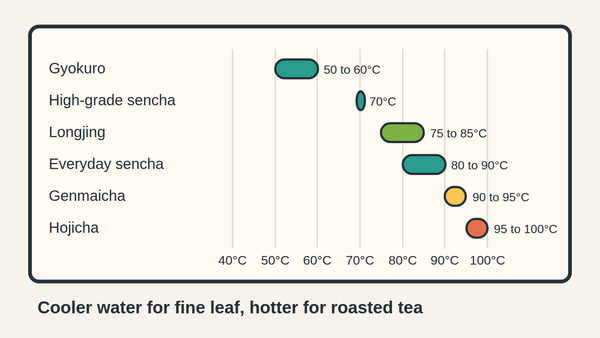
Knowing the type tells you how to brew it, and that matters more than most people think. Gyokuro wants water near 50 to 60°C, while hojicha wants it close to boiling, and using one tea's method on the other ruins both. The next piece in this series, how to brew green tea without bitterness, turns the categories above into a working brewing chart.
This article is independent analysis by House of Agile. It draws on the Japan Tea Central association's labelling standard, Chinese and EU geographical indication records and peer-reviewed food science. It is not affiliated with any tea producer or retailer.
Sources
Japanese standards
- Japan Tea Central Public Interest Incorporated Association, Green Tea Labelling Standard (type definitions, shading periods, harvest terms, prohibited claims), revised March 2019. https://nihon-cha.or.jp/pdf/hyoujikijyun.pdf
- Japan Tea Central Public Interest Incorporated Association, overview of the labelling standard. https://www.nihon-cha.or.jp/standard.html
Processing science
- Review of green tea processing and catechin chemistry, PMC. https://pmc.ncbi.nlm.nih.gov/articles/PMC10314197/
- Review of tea polyphenol oxidase and oxidation, PMC. https://pmc.ncbi.nlm.nih.gov/articles/PMC3857408/
- Study of colour and pigment changes during green tea processing and storage, PMC. https://pmc.ncbi.nlm.nih.gov/articles/PMC11564038/
- Comparison of steamed and pan-fired green tea volatiles, 2022, PMC. https://pmc.ncbi.nlm.nih.gov/articles/PMC9180411/
- Study of steamed green tea processing in China, 2023, PMC. https://pmc.ncbi.nlm.nih.gov/articles/PMC10648715/
- Food Chemistry, effect of baking versus fixation method on green tea sensory quality, 2022. https://pubmed.ncbi.nlm.nih.gov/35101788/
- Study of baked green teas (pan fixation followed by bake drying), PMC. https://pmc.ncbi.nlm.nih.gov/articles/PMC10051951/
- Study of Longjing pan-firing stages and aroma, PMC. https://pmc.ncbi.nlm.nih.gov/articles/PMC11083364/
- Study of Biluochun aroma, PMC. https://pmc.ncbi.nlm.nih.gov/articles/PMC10650078/
- Study of Taiping Houkui processing, PMC. https://www.ncbi.nlm.nih.gov/pmc/articles/PMC11087968/
- Shading trials on tea shoots: chlorophyll, theanine and catechins, FAO AGRIS record. https://agris.fao.org/search/en/providers/122558/records/67655b4a6a5a95f3405aad6a
- Effect of shading method and duration on tea leaf composition, PubMed. https://pubmed.ncbi.nlm.nih.gov/29722013/
Origins and geographical indications
- European Commission, Implementing Regulation (EU) No 449/2011 registering Longjing Cha as a PDO. https://eur-lex.europa.eu/LexUriServ/LexUriServ.do?uri=OJ:L:2011:122:0067:0068:EN:PDF
- China Ministry of Commerce, EU and China geographical indications agreement, list of protected names including Lu'an Guapian. http://ipr.mofcom.gov.cn/hwwq_2/chn_eu_gi/file/EN.pdf
- Longjing regional standard (grades and permitted cultivars). https://www.ttbz.org.cn/Home/PdfFileStreamGet/c3QsMTMyMTg1
- State Administration for Market Regulation, Huangshan Maofeng GI standard record. https://std.samr.gov.cn/gb/search/gbDetailed?id=FD5CCCE5626B20A3E05397BE0A0ABF7D
- China Ministry of Agriculture and Rural Affairs, Huangshan Maofeng profile. https://gjcr.moa.gov.cn/cxf/202005/t20200516_6344249.htm
- Hubei Provincial Department of Culture and Tourism, Biluochun craft and harvest timing. https://wlt.hubei.gov.cn/hbsfwzwhycw/mtgz/mtgz_fyw/202212/t20221228_4467898.shtml
- Anhui News, Taiping Houkui origin and harvest. http://english.anhuinews.com/special1/202208/t20220812_6293836.html
- BBC Travel, on West Lake Longjing and its protected zone, May 2026. https://www.bbc.com/travel/article/20260508-on-the-hunt-for-chinas-most-famous-green-tea
Tea retailer
- Ta Tea Tam, French online tea shop, green tea range and shipping terms (checked October 2026). https://www.tateatam.fr/