Green Tea Gear and Where to Buy Good Leaf: A 2026 Buyer's Guide
The temperature-control kettles that test accurately, which teapots suit which teas, matcha tools worth buying, 2026 green tea prices, the matcha shortage and starter kits at three budgets.
Coffee people can spend a small fortune on grinders, scales and espresso machines. Green tea asks for much less. Almost everything that goes wrong in a cup comes down to water temperature and contact time, so the one piece of gear that genuinely changes results is a kettle that lets you choose the temperature. After that, you need something that gives the leaves room and lets you pour off all the tea quickly. Everything else is pleasure, not necessity.
This is the last part of our green tea series. If you have not read it yet, how to brew green tea without bitterness explains why temperature matters so much, and the guide to green tea types explains what you are buying.
Start with the kettle
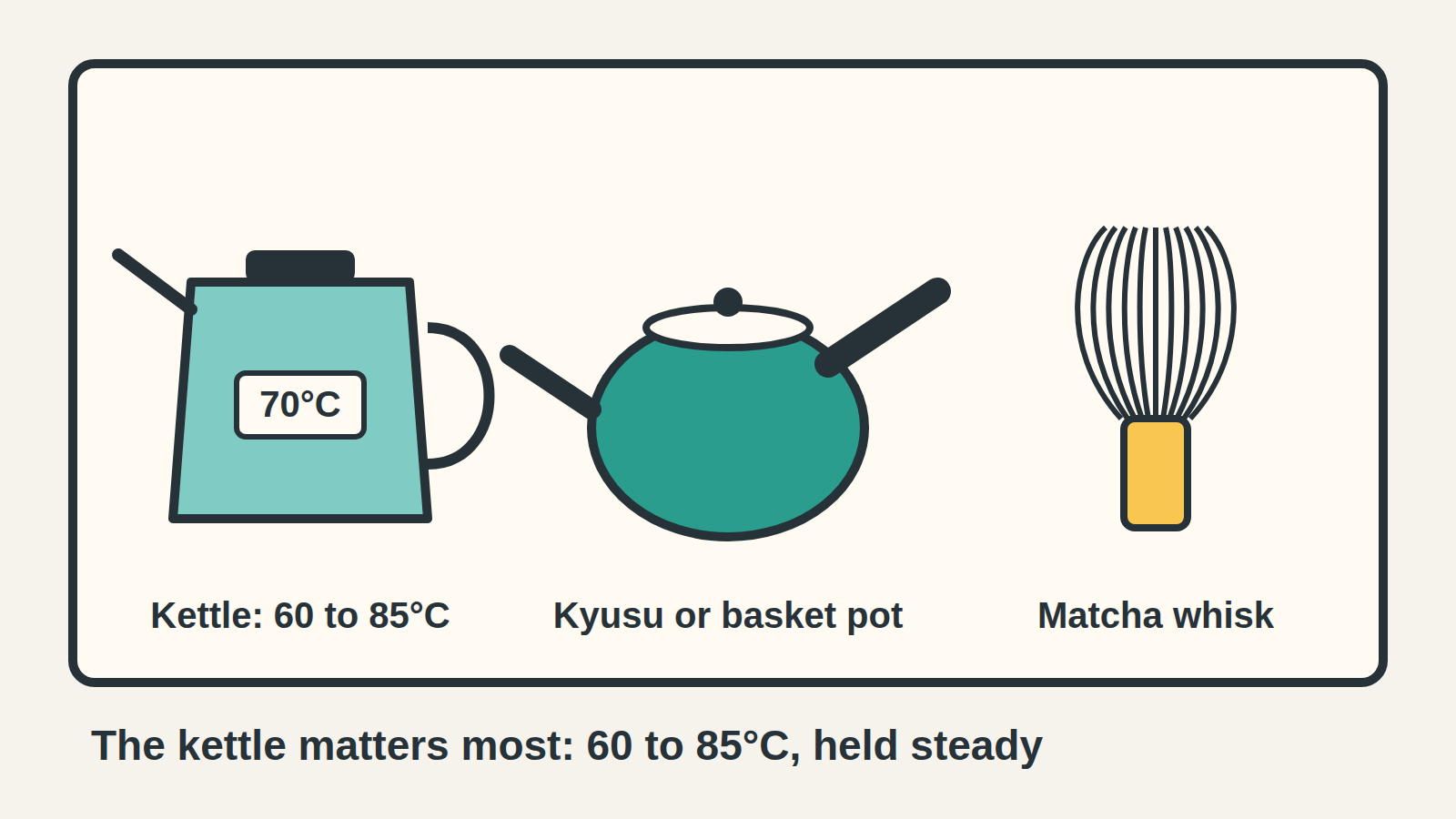
You do not need one-degree precision. A kettle that reliably reaches 60 to 85°C, holds within about 3°C and pours cleanly covers every green tea. Here is what independent testers found.
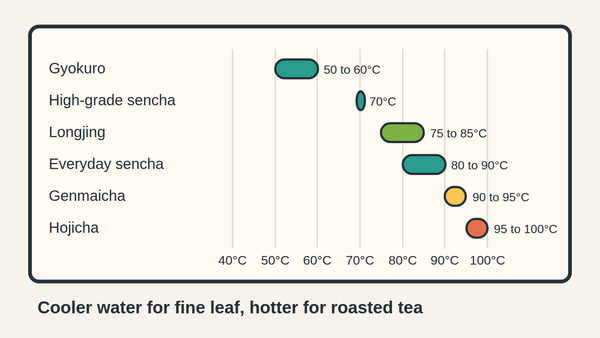
In Europe, the Rommelsbacher WK 3000 won Stiftung Warentest's kettle test in its March 2025 issue, scoring "Gut" (2.0) overall and 1.5 for boiling and keeping warm. It has six presets at 45, 60, 70, 80, 90 and 100°C, which line up neatly with gyokuro, sencha and hojicha, plus a 30-minute keep-warm. It lists at €59.99 from the manufacturer. Stiftung Warentest's public summary does not give temperature deviations in degrees.
In the US, the Cuisinart CPK-17P1 PerfecTemp is Wirecutter's top pick, updated March 2026. In its testing the kettle held within about 2°F of its 185°F setting after 30 minutes on keep-warm. It has six presets, a 1.7 litre capacity and a three-year warranty, and sells for roughly $130 to $140. Buy the exact CPK-17P1 model number; older CPK-17 variants differ.
Other good options:
- Cuisinart GK-1 (US, about $120). A gooseneck with 5-degree steps and the best accuracy in Wirecutter's test pool. The slow gooseneck pour is not needed for tea, but it does no harm.
- Breville IQ Kettle in the US, Sage Smart Kettle in Europe (about $180 and €160). Five presets and a 20-minute keep-warm. The European manual allows a variation of plus or minus 3°C.
- Fellow Corvo EKG Pro (about $180 to $200 in the US, €149 to €230 in Europe). Degree-by-degree control and a wide spout made for tea, in a compact 0.9 litre body. Serious Eats rated the earlier Corvo EKG its best tea kettle.
- Fellow Stagg EKG Pro. Excellent if you also make pour-over coffee. For tea alone, its narrow gooseneck and 0.9 litre capacity add little.
One safety point: buy the version made for your country. A 120 V American kettle must not be run on 230 V European power, and swapping the plug does not fix that. Fellow explicitly warns against using its US kettles abroad.
A pot, or just a basket
What matters is that the leaves can open up and that you can pour off every drop quickly, so the leaf does not keep steeping.
- Kyusu (side-handle teapot). The classic for sencha and kabusecha, usually 200 to 350 ml. The side handle makes a fast one-handed pour easy. Tokoname ware is the versatile classic; Banko ware tends to hold heat longer. Good production pots run about €35 to €90, artisan pieces €100 to €300 and up.
- Houhin and shiboridashi. Small handleless vessels for gyokuro and fine sencha brewed cool and concentrated, often 35 to 120 ml for a shiboridashi. Production pieces start around €20 to €50.
- Gaiwan. A lidded porcelain bowl, about €9 to €40. Neutral, easy to clean and ideal for Chinese green teas, though pouring from under the lid takes practice and fine Japanese leaf can escape.
- Glass teapot. A good first pot, especially if you switch between teas. The Hario ChaCha Kyusu Maru costs from about $21.50 in the US and €29 to €55 in Europe. Choose a large removable basket over a small capsule.
If you buy a kyusu, check the filter:
- A wrap-around stainless mesh is the safest choice for deep-steamed fukamushi sencha, because it keeps draining even when fine particles cover part of it.
- A ceramic filter built into the spout keeps tea away from metal and suits whole-leaf sencha, but can clog with very fine leaf.
- "Ball filter" can mean a useful dome over the spout or a cramped removable basket. Look at the photos before you buy.
Do you need a pot at all? Not to start. A large basket infuser that sits across the mug works well, because the leaves have room to expand. Serious Eats tested ten and picked the Fenshine basket (about $8), with Finum and OXO as further recommendations. Tea balls are fine for small amounts of compact leaf but too cramped for most whole-leaf green tea. In Europe, the Whittard mug infuser (€13.95) is a cheap start.
For travel bottles, choose one whose filter basket you can remove completely once the tea is ready. A permanently submerged infuser keeps steeping while you travel, and an insulated bottle keeps the water hot enough to over-steep, which turns green tea bitter.
Matcha tools
- Chasen (bamboo whisk). The one essential. An 80-prong whisk is sturdy and beginner-friendly. Basic sets start around $13 to $15; good standalone Japanese whisks run $24 to $53. There is no fixed lifespan: Ippodo advises replacing it when many tips have broken or whisking gets harder. Soak it for a minute or two before use, rinse with plain water (never soap), and let it dry in open air.
- Sifter, about $11 to $32. Worth it. Sifting breaks up clumps and does more for smoothness than extra whisking.
- Chawan (bowl). A wide, stable bowl helps, but any wide cereal bowl works to start. Production bowls run about $29 to $70.
- Chashaku (bamboo scoop) and whisk stand. Nice, not necessary. A small scale is more consistent than a scoop.
An electric frother is fine for lattes and iced matcha, especially with sifted powder. For straight matcha it makes larger bubbles than a whisk, and for thick koicha, which is kneaded rather than whipped, a chasen is clearly better.
Storage that actually matters
Green tea fades fast once opened. Oxygen, light, heat, moisture and strong smells all dull it. Ippodo recommends rolling the original foil bag tight, clipping it and keeping it in a tin, and finishing opened matcha within about a month.
- A double-lid tea tin (chazutsu), around €17, is the best simple purchase. Pick one close to the size of what you buy.
- Vacuum canisters help with large bags opened often, but we found no tea-specific evidence that they beat a good tin for tea finished within four to six weeks, and clear ones let in light.
- Fridge and freezer are for unopened reserve packs, sealed tight. Let them reach room temperature before opening, or moisture condenses on the leaf.
Buying the tea itself
Prices only mean something next to the harvest, the origin and the pack size. As of October 2026, these are typical bands per 100 g:
- Supermarket green tea bags: about €2 to €13, or $4 to $12. Fine for convenience, but a different product from loose leaf.
- Everyday loose sencha: about €10 to €25, or $14 to $30.
- High-grade gyokuro: about €25 to €90, or $35 to $150. A very cheap "gyokuro" is often karigane, the stem tea.
- Longjing: about €20 to €80, or $20 to $120. Verified West Lake and pre-Qingming lots cost more.
- Matcha sold as "ceremonial": compare per gram. Most sits around €0.75 to €1.25 per gram in Europe and $0.65 to $1.65 in the US.
- Culinary matcha: typically €0.07 to €0.47 per gram, or $0.15 to $0.40.
Why matcha got expensive. Demand for matcha exploded through cafés, social media and tourism just as supply tightened. Tencha, the leaf matcha is made from, needs weeks of shading, special drying equipment and slow milling, and new fields take about five years to produce. The 2025 first flush was hit by weather. At the opening Kyoto tencha market in May 2025, machine-picked tencha averaged ¥8,235 per kilo, about 170% more than a year earlier, according to Reuters. Japan's green tea exports roughly doubled in value in 2025, to ¥72.0 billion, and powdered tea including matcha made up 84% of that. Ippodo and Marukyu Koyamaen rationed purchases, and Ito En raised some ceremonial matcha prices by up to 100% from September 2025.
"Ceremonial grade" is not regulated. No Japanese, EU, US or ISO rule defines it. Under the Japanese industry definition, matcha is finely ground tencha; powdered sencha is a different product. Instead of the word "ceremonial", look for:
- 100% tencha, with the country, prefecture and ideally the producer named;
- the harvest (first flush is best for drinking straight) and a milling or packing date;
- a vivid natural green in daylight, not khaki, yellow or neon;
- a fine, smooth texture that whisks into a stable foam;
- small, opaque, sealed packaging with a lot code.
Red flags on any green tea: no harvest or packing date on an expensive spring tea; vague origin phrases like "Japanese style" or "Uji style"; "certified ceremonial" with no certifier named; a price too low for all the claims on the pack; sugar, milk powder or colouring in a "matcha"; and stale smells such as cardboard, hay or old spices. "Uji" itself means finished by a Kyoto business, not necessarily grown in Uji, and "organic" certifies farming rules, not freshness or the absence of every residue.
Because matcha is eaten whole, lab results per lot matter too. We cover the recent contamination alerts in what the evidence says about green tea and health.
Where we buy. For loose leaf in Europe, we like Ta Tea Tam, a small French online shop with a strong green tea range: Japanese sencha, bancha, hojicha and genmaicha from Fujieda in Shizuoka, a first-flush Yabukita sencha, a shincha and organic Chinese greens such as Longjing. Everyday Fujieda sencha starts from €10. The site is in French; shipping is €5 in mainland France and €7 to the rest of the world, free on orders from €45. Its brewing notes match the advice in this series: about 75°C, one minute, and filtered water.
Disclosure: House of Agile works with Ta Tea Tam on the technical side of its online shop. These are not affiliate links, and we earn nothing from purchases made through them.
Three starter kits
These assume you already own cups and leave the tea itself out, so the budgets compare like with like.
About €30 or $30
- Europe: Whittard mug infuser (€13.95) plus a double-lid tea tin (about €17). Total about €31.
- US: OXO basket infuser (about $17) plus a basic matcha set with whisk, scoop and sifter (about $15). Total about $32.
About €80 or $80
- Europe: Rommelsbacher WK 3000 kettle (€59.99) plus the Whittard mug infuser (€13.95). Total about €74. The best functional starting point.
- US: Hario ChaCha Kyusu Maru ($21.50), OXO basket (about $17) and a basic matcha set (about $15). Total about $53, leaving room for good tea or a tin.
About €200 or $200
- Europe: Rommelsbacher WK 3000 (€59.99), a Tokoname kyusu (about €80), the mug infuser (€13.95) and a tin (about €17). Total about €171; put the rest toward a good chasen or better tea.
- US: Cuisinart CPK-17P1 kettle (about $130 to $140), Hario ChaCha Kyusu Maru ($21.50), OXO basket (about $17) and a basic matcha set (about $15). Total about $185 to $195.
At the top budget, put the money into accurate heating and a roomy pot before artisan pottery.
What to buy and where it fits
As an Amazon Associate, House of Agile earns from qualifying purchases. Prices and availability change, so check the current listing before buying.
These searches match the kits above. Check the model number and, for kettles, the voltage before you buy.
- Variable-temperature electric kettle (Kettle). Best for: Hitting 60 to 80°C for sencha and gyokuro without a thermometer. In short: look for presets or degree control and a keep-warm function. Watch out: buy the voltage for your country, and the exact model number. Compare options on Amazon
- Kyusu teapot with stainless mesh filter (Teapot). Best for: Everyday sencha and fukamushi. In short: 200 to 350 ml, side handle, wrap-around mesh filter. Watch out: a ceramic filter can clog with deep-steamed tea. Compare options on Amazon
- Glass teapot with removable basket (Teapot). Best for: Beginners and households that switch teas. In short: a large basket, heat-resistant glass. Watch out: small capsule infusers cramp the leaves. Compare options on Amazon
- Basket tea infuser (Infuser). Best for: Brewing loose leaf in any mug. In short: wide enough to sit across the rim, with a lid that doubles as a drip tray. Watch out: tea balls are too small for most green tea. Compare options on Amazon
- Matcha whisk set (Matcha). Best for: Straight matcha with a fine foam. In short: an 80-prong bamboo chasen, plus a sifter. Watch out: never wash the whisk with soap; let it dry in open air. Compare options on Amazon
- Double-lid tea tin (Storage). Best for: Keeping opened tea fresh. In short: opaque, with an inner and an outer lid, close to the size of your pack. Watch out: clear jars let in light. Compare options on Amazon
This article is independent analysis by House of Agile, based on published tests from Stiftung Warentest, Wirecutter and Serious Eats, manufacturer specifications and retail listings checked in October 2026. Prices change; check the current listing before buying.
Sources
Comparative testing
- Wirecutter (The New York Times), The Best Electric Kettle, updated March 2026. https://www.nytimes.com/wirecutter/reviews/the-best-home-kettle/
- Stiftung Warentest kettle test, issue 03/2025, result summary for the Rommelsbacher WK 3000. https://www.guenstiger.de/Produkt/Rommelsbacher/WK_3000_3.html
- Serious Eats, The Best Tea Kettles, February 2025. https://www.seriouseats.com/best-tea-kettles-7506070
- TechGearLab, Best Electric Kettle, April 2025. https://www.techgearlab.com/topics/kitchen/best-electric-kettle
- Serious Eats, best gear for brewing and drinking tea (infuser test). https://www.seriouseats.com/best-gear-for-brewing-and-drinking-tea-8625113
Manufacturer specifications
- Rommelsbacher, WK 3000 kettle. https://www.rommelsbacher.de/en/wasserkocher-wk-3000
- Breville, IQ Kettle (US). https://www.breville.com/en-us/product/bke820
- Sage Appliances, Smart Kettle (Europe). https://www.sageappliances.com/en-ie/product/bke825?sku=SKE825BSS3GUK1
- Sage, BKE825 instruction manual (temperature tolerance). https://www.breville.com/content/dam/sage/eu/en/assets/miscellaneous/instruction-manual/tea/BKE825-instruction-manual.pdf
- Fellow, Corvo EKG kettle and voltage notes. https://fellowproducts.com/products/corvo-ekg
- Hario USA, ChaCha Kyusu Maru. https://www.hario-usa.com/products/maru-chacha-kyusu-tea-pot
- Hario Europe, ChaCha Kyusu Maru. https://www.hario-europe.com/products/teapot-cha-cha-kyusu-maru
Matcha and storage guidance
- Ippodo Tea, utensils range and prices. https://ippodotea.com/collections/utensils
- Ippodo Tea, how long to use a chasen. https://ippodotea.com/blogs/frequently-asked-questions/how-long-can-i-use-my-chasen
- Ippodo Tea, all about the chasen (care). https://ippodotea.com/blogs/ippodo-tea-blog/all-about-the-chasen
- Ippodo Tea, chasen pointers and matcha preparation. https://ippodotea.com/blogs/recipes-to-brew-japanese-tea/chasen-pointers
- Ippodo Tea, frequently asked questions (storage). https://ippodotea.com/blogs/frequently-asked-questions
Retail listings (checked 2026)
- Yoshi En, Japanese teapots. https://www.yoshien.com/en/teaware/teapots/
- Yunomi, shiboridashi and houhin. https://yunomi.life/en-fr/collections/shiboridashi-houhin
- Tea Gallery, gaiwans. https://teagallery.eu/collections/gaiwans
- Whittard, tea infusers and strainers. https://www.whittard.com/en-fr/collections/tea-infusers-strainers
- Williams Sonoma, Fellow Corvo EKG Pro. https://www.williams-sonoma.com/products/fellow-corvo-ekg-pro-electric-kettle/
- Idealo, Fellow Corvo EKG Pro European prices. https://www.idealo.at/preisvergleich/OffersOfProduct/206586183_-corvo-ekg-pro-fellow.html
- Yoshi En, Japanese green tea range and prices. https://www.yoshien.com/gruener-tee/japan/
Matcha market and labelling
- Reuters, Japan's heat-stressed matcha output struggles to meet demand, July 2025. https://www.reuters.com/business/japans-heat-stressed-matcha-tea-output-struggles-meet-soaring-global-demand-2025-07-04/
- JETRO, Japanese green tea exports report, 2026. https://www.jetro.go.jp/biz/areareports/2026/d7cf7db2e5a71454.html
- Marukyu Koyamaen, purchase limits on matcha, March 2025. https://www.marukyu-koyamaen.co.jp/information/news-2956/
- Ippodo Tea, message from the president on supply and pricing, July 2025. https://ippodotea.com/blogs/ippodo-tea-blog/presidents-message
- Bloomberg, Ito En to double some matcha prices, July 2025. https://www.bloomberg.com/news/articles/2025-07-31/global-thirst-for-matcha-drives-top-japanese-tea-brand-to-double-prices
- The Japan Times, Japan struggles to fend off a world without enough matcha, February 2025. https://www.japantimes.co.jp/life/2025/02/23/food-drink/matcha-shortage-global-solutions/
- Yamamasa Koyamaen, what is matcha (industry definition). https://www.yamamasa-koyamaen.co.jp/en/matcha/basic/about-matcha.html
- Japan Tea Central Public Interest Incorporated Association, Green Tea Labelling Standard. https://nihon-cha.or.jp/pdf/hyoujikijyun.pdf
Tea retailer
- Ta Tea Tam, French online tea shop, green tea range and shipping terms (checked October 2026). https://www.tateatam.fr/