What a home CO2 monitor actually measures, and which sensor to buy

A CO2 monitor measures how well a room is ventilated, not how toxic the air is. How to read the parts per million, the thresholds worth acting on, and why a true NDIR sensor beats the cheap estimated-CO2 units.
A home CO2 monitor measures how well a room is ventilated, not how toxic the air is. The number on the screen tells you how much of the air you are breathing is fresh and how much has already passed through someone's lungs, and the single thing that decides whether that number is real or invented is the sensor type: true NDIR measures carbon dioxide, while cheaper eCO2 units only guess at it.
This is a decision guide, not a product list. Below: what the parts per million figure represents, the thresholds that should change what you do, the sensor distinction the market quietly blurs, and the limits of what the device can tell you at all.
What the CO2 number actually means
Outdoor air sits at roughly 420 parts per million of carbon dioxide, and that is the floor your indoor air can reach with the windows open. People push it up just by being in the room. Every exhalation adds CO2, so in a closed space the concentration climbs steadily until fresh air arrives to flush it out. How fast it climbs depends on how many people are present, how large the room is, and how much outdoor air is leaking or being pushed in.
That is the entire logic of the device. Carbon dioxide at household levels is not the health threat people imagine it to be. What it tracks is the freshness of the air, and stale air carries everything else with it: other people's exhaled aerosols, the slow buildup of odours, the general sense of a room going close. A low reading means the room is being well flushed and whatever else is in the air is being diluted too. A high reading means ventilation is poor. That is the actionable part. The monitor cleans nothing. It tells you when to open a window.
The thresholds worth acting on
A reading scale, from genuinely fresh to act now:
- Around 420 ppm: outdoor air, the practical floor.
- Under 800 ppm: well ventilated.
- 800 to 1000 ppm: acceptable.
- Crossing 1000 ppm: your cue to ventilate.
- 1400 ppm and above: the room needs fresh air now.
These come from established guidance, not a vibe. The German Environment Agency, building on a hygienic benchmark more than a century old, treats indoor CO2 below 1000 ppm as harmless, 1000 to 2000 ppm as elevated and a prompt to ventilate, and above 2000 ppm as hygienically unacceptable. That 1000 ppm line is the classic Pettenkofer number, still the most cited threshold for everyday indoor air. The stricter 800 ppm target is post-2020 REHVA guidance, aimed at spaces where people gather and the goal is reducing shared air rather than just comfort.
None of these are poisoning levels. They are stages of staleness.
Does a stuffy room actually matter for thinking?
There is a measurable cognitive cost, not just a comfort one. A Harvard study of office workers found higher-order decision-making scores dropping as CO2 rose, with the effect already visible at concentrations many rooms reach by mid-afternoon. The exact size of the effect is debated. The direction is not, and it gives a concrete reason to watch the number: a closed, stuffy room is a worse room to think in, and the monitor is the cheapest way to catch it happening in real time.
NDIR vs eCO2: the sensor distinction that decides everything
Check this before anything else, because it is where the cheap end of the market misleads people. Two completely different methods can put a CO2 figure on a screen, and only one is a measurement.
A true sensor uses nondispersive infrared, or NDIR. It shines infrared light through a small chamber of air. Carbon dioxide absorbs a specific wavelength, so the sensor reads how much was absorbed and calculates the actual concentration. That is a direct, physical measurement of CO2 itself.
The cheaper approach never touches carbon dioxide. These units carry a metal-oxide sensor that detects volatile organic compounds, the broad class of chemicals from cleaning products, furniture, cooking, and people, then estimate a CO2 figure from that reading. The output is usually labelled eCO2, the small letter standing for equivalent or estimated. An eCO2 sensor can move in roughly the right direction when a room fills up, but it is inferring, not measuring, and a spray of cleaner or a whiff of alcohol can throw it off while it reports a confident, wrong number. If a device pairs a low price with an eCO2 or total-VOC sensor, read its carbon dioxide figure as a mood indicator, not data. For the threshold logic above to hold, you want NDIR.
Calibration: the other half of an honest reading
Even a real NDIR sensor drifts, and how it corrects for that drift matters. Most consumer units use automatic baseline calibration: over a span of days they assume the lowest CO2 they have seen must be fresh outdoor air at about 420 ppm, and reset to that floor. In a normal home where windows open regularly, this works without any thought from you.
It fails in one case. A room occupied almost constantly and rarely fully aired, like a bedroom that never drops to outdoor levels, can let the automatic baseline anchor too high, and the sensor starts under-reporting. The fix is small: park the monitor outdoors or at a wide-open window now and then so it sees genuinely fresh air, or choose a unit that allows manual calibration. That habit is the difference between a number you can trust and one that quietly lies to you.
What to do when the number climbs
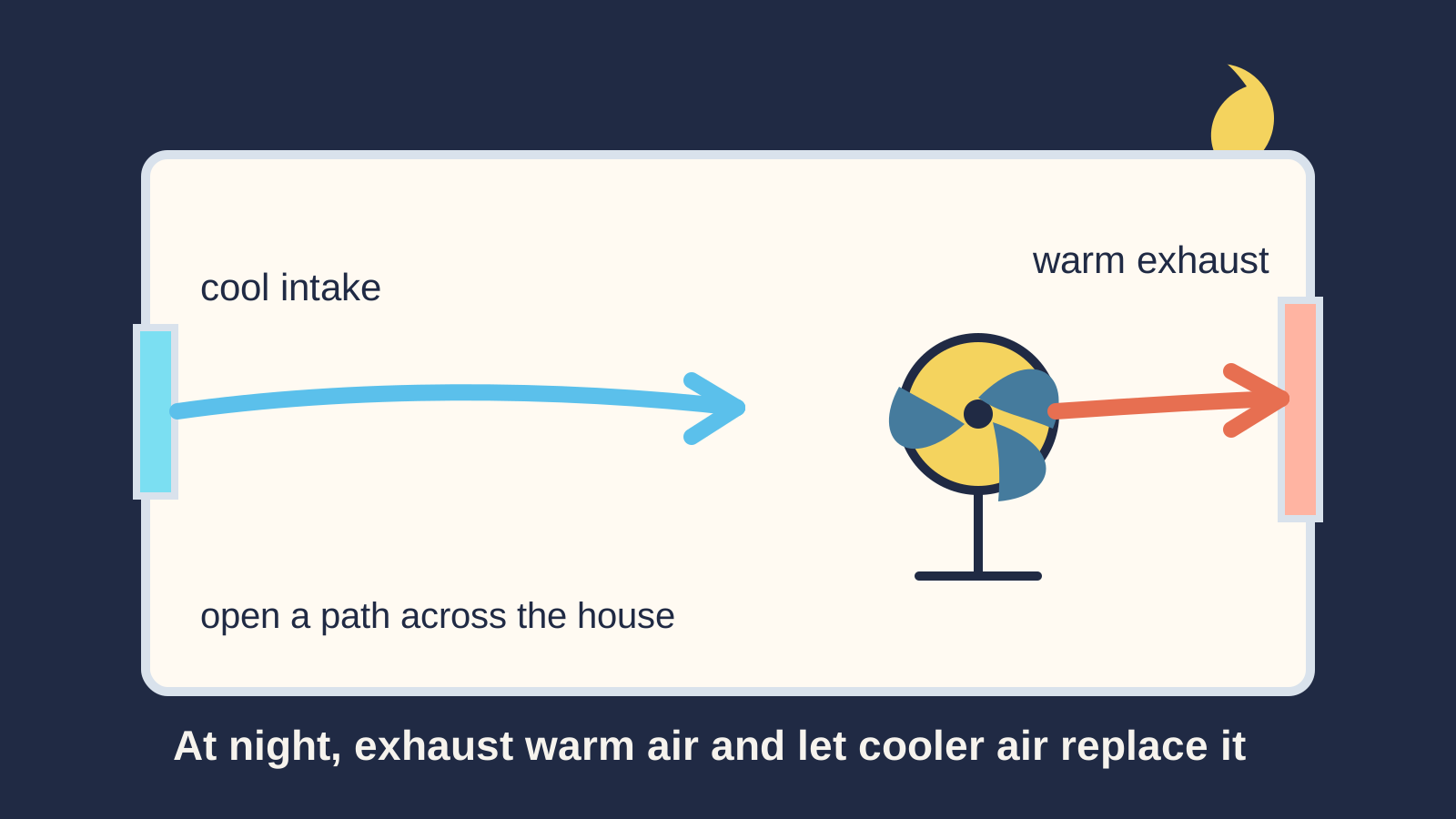
A monitor only earns its place if it changes your behaviour, and the effective actions are dull. The fastest is cross-ventilation: open windows, or a window and a door, on opposite sides of a space for a few minutes. The through-draught flushes stale air far quicker than one window cracked open. Watch the figure drop from well over 1200 back toward outdoor levels in minutes and the point of the device becomes obvious.
For rooms that cannot be aired easily, mechanical ventilation does the same job continuously. A heat-recovery or energy-recovery unit pulls in outdoor air while reclaiming most of the warmth from the air it expels, which is how you ventilate through a cold season without throwing heat out the window. The case that surprises people most is the bedroom overnight: a closed door, two sleepers, no airflow, and CO2 can pass 2000 ppm by morning. That alone argues for a vent, an open door, or a cracked window while you sleep.
What a CO2 monitor does not do
The limits matter as much as the capability. A CO2 monitor measures carbon dioxide and nothing else. It does not detect carbon monoxide, the combustion gas that is genuinely dangerous and needs its own dedicated alarm. The similar names cause real harm here: a CO2 monitor is not a substitute for a CO alarm, and you need both, for different reasons. It does not measure radon. It does not measure the fine particulate from cooking or wildfire smoke. It does not measure the volatile organic compounds an air purifier with a carbon stage would target.
That last gap points to the other half of indoor air. CO2 is about ventilation; particles are a separate problem with separate hardware, and the two are easy to confuse. If your concern is pollen, dust, or smoke rather than stuffiness, the metric that matters is filtration capacity, not parts per million, which is covered in how to size an air purifier. A purifier and a CO2 monitor answer different questions, and one does not cover the other's job.
How to choose without overpaying
Stripped down, the decision is a few checks, not a brand:
- Confirm the sensor is true NDIR, not an eCO2 or VOC estimate. That alone separates a measurement from a guess.
- Favour a display you will actually glance at. A clear ambient number or a simple colour cue changes behaviour more than a graph buried in an app.
- Decide whether you need logging and history or just a live readout on the desk.
- Check that calibration can be managed: automatic for most rooms, manual for the constantly occupied ones.
Get those right and almost any reputable NDIR unit will serve. What you are buying is not really a gadget. It is the habit of opening a window at the right moment, made visible.
What to buy and where it fits
As an Amazon Associate, House of Agile earns from qualifying purchases. Prices and availability change, so check the current listing before buying.
The sensor type is the whole decision. Use these searches as a starting point and confirm in each listing that the sensor is NDIR, not an eCO2 or VOC estimate.
- NDIR CO2 monitor with a display (Desk or wall unit). Best for: A live number you glance at in a home office, living room, or bedroom. In short: true NDIR sensor, clear screen or colour cue, automatic baseline calibration. Watch out: Listings that say eCO2 or TVOC are estimating CO2, not measuring it. Compare options on Amazon
- CO2 monitor with logging (History and app). Best for: Seeing what a bedroom does overnight or how fast a room goes stale with guests. In short: NDIR sensor plus stored history, often with manual calibration. Watch out: A graph buried in an app changes behaviour less than a number on the desk. Compare options on Amazon
- Carbon monoxide alarm (Safety, separate job). Best for: Any home with a gas boiler, stove, fireplace, or attached garage. In short: a dedicated CO alarm, not a CO2 monitor. Watch out: A CO2 monitor does not detect carbon monoxide; you need both. Compare options on Amazon
This article is independent analysis by House of Agile. It reflects public health, building-science, and standards guidance and general physics, not professional medical, indoor-air-quality, or purchasing advice. CO2 guideline values vary by country and context, and a carbon dioxide monitor is not a substitute for a carbon monoxide alarm. Verify the sensor type, calibration method, and specifications of any specific unit before buying.
Sources
CO2 guideline values and thresholds
- German Environment Agency (Umweltbundesamt), Committee on Indoor Air Guide Values, "Health evaluation of carbon dioxide in indoor air." Indoor CO2 below 1000 ppm is hygienically harmless, 1000 to 2000 ppm is elevated and a prompt to ventilate, and above 2000 ppm is hygienically unacceptable; builds on the historical Pettenkofer 1000 ppm benchmark. https://www.umweltbundesamt.de/en/topics/health/commissions-working-groups/committee-on-indoor-air-guide-values
- Wisconsin Department of Health Services, "Carbon Dioxide." Background levels around 400 ppm outdoors, plus the typical indoor ranges and the parts-per-million scale used to judge ventilation and stuffiness in occupied spaces. https://www.dhs.wisconsin.gov/chemical/carbondioxide.htm
Ventilation standards and targets
- REHVA (Federation of European Heating, Ventilation and Air Conditioning Associations), COVID-19 ventilation guidance. Recommends using CO2 as an indicator of ventilation and keeping concentrations below roughly 800 ppm in occupied gathering spaces as a marker of good ventilation. https://www.rehva.eu/activities/covid-19-guidance
- ASHRAE Standard 62.1, "Ventilation and Acceptable Indoor Air Quality." The reference standard for minimum ventilation rates that keep indoor air acceptable; CO2 is commonly used as a real-time proxy for whether those rates are being met. https://www.ashrae.org/technical-resources/bookstore/standards-62-1-62-2
Cognitive effects and sensor technology
- Allen, J. G., et al. (2016), "Associations of Cognitive Function Scores with Carbon Dioxide, Ventilation, and Volatile Organic Compound Exposures in Office Workers," Environmental Health Perspectives (Harvard COGfx study). Measured declines in higher-order cognitive-function scores as indoor CO2 rose to levels common in occupied buildings. https://ehp.niehs.nih.gov/doi/10.1289/ehp.1510037
- Aranet, "Best CO2 monitors 2026: accurate NDIR picks for homes, schools, and facilities." Explains that nondispersive infrared (NDIR) sensors directly measure CO2 by infrared absorption, whereas cheaper metal-oxide sensors estimate an eCO2 value from volatile organic compounds rather than measuring carbon dioxide. https://aranet.com/en/home/blog/best-co2-monitors-2026-accurate-ndir-picks-for-homes-schools-and-facilities