How to Size an Air Purifier for Pollen, Dust, and Smoke
A purifier is only as good as its Clean Air Delivery Rate matched to your room. How to read CADR, what HEPA filters actually remove, and why particles and gases need different filters.
Most people buy an air purifier by the picture on the box and the room size printed on the front. Both can mislead you. The number that actually predicts whether a purifier will clear pollen, dust, or smoke is its Clean Air Delivery Rate, or CADR, and whether that rate is large enough for the volume of air you are asking it to clean. Get the CADR-to-room match right and almost any reputable unit will work. Get it wrong and an expensive machine quietly underperforms in a room that is too big for it.
This is a decision guide, not a product list, about the one metric that travels across every brand and the honest limits of what these machines do.
What CADR actually measures
CADR was developed by the Association of Home Appliance Manufacturers, the industry standards body known as AHAM. It is a measurement of how fast an air cleaner filters particles, reported in cubic feet of clean air per minute. The higher the number, the more particles the unit removes and the larger the area it can serve.
The important detail is that a purifier does not get one CADR score, it gets three. AHAM rates each unit against three particle sizes: tobacco smoke, dust, and pollen. Smoke is the smallest of the three, so the smoke CADR is the toughest test and the most useful single number if you care about fine particles. Pollen is the largest, dust sits in the middle. A high pollen CADR with a weak smoke CADR tells you the machine handles big spring allergens but struggles with the fine stuff in wildfire haze.
One safeguard worth knowing: AHAM runs a certification programme called AHAM Verifide. Units carrying that seal have been tested by an independent laboratory to confirm the product performs to the manufacturer's stated claims, rather than to a number the brand simply chose for itself.
Matching CADR to your room, the rule that matters
A purifier clears a room by cycling its entire volume of air through the filter, repeatedly, per hour. Air-quality professionals describe this as air changes per hour, or ACH. For allergy sufferers, the widely cited target is roughly five air changes an hour, which keeps particle levels low rather than letting them build back up between cycles.
AHAM gives a simple way to hit that target without doing the volume maths yourself: choose a unit whose smoke CADR is at least two-thirds of the room's floor area in square feet. A 200 square foot room, on that rule, needs a smoke CADR of at least 132. That two-thirds figure is calibrated to deliver the air changes an allergy household wants.
Two adjustments matter. First, CADR ratings assume a standard eight foot ceiling. If your room has high or vaulted ceilings, there is more air volume than the floor area suggests, and you need extra capacity to compensate. Second, wildfire smoke is a harder case. For smoke episodes, AHAM recommends sizing up so the smoke CADR equals the room's area in square feet, not two-thirds of it, because you want more aggressive turnover when the outdoor air is genuinely hazardous. In practice, sizing for the smoke case buys you headroom for everything else.
A useful habit is to size generously. A purifier rated well above your room can run on a lower, quieter setting and still hit your air changes, which matters more than most buyers expect.
HEPA and what the filter types do
Portable air cleaners usually reach a high CADR by pulling air through a high-efficiency particulate air filter, the HEPA filter. The standard behind that name is specific. A true HEPA filter is defined to remove at least 99.97 percent of airborne particles at 0.3 microns in size. That particular size is the hardest one to catch, the most penetrating particle size, so particles both larger and smaller are trapped at even higher rates. This is why HEPA is the workhorse for pollen, dust, and the fine particulate in smoke alike.
Watch the wording on the box. Phrases like HEPA-type or HEPA-style are not the same as a tested HEPA filter, and the difference shows up in real-world capture. The CADR number is the more reliable check, because it reflects measured performance of the whole machine, filter and fan together, not just a filter label.
Many purifiers also include a pre-filter, a coarse layer that catches hair, lint, and large debris so the HEPA filter is not clogged prematurely. That is housekeeping for the expensive filter behind it, not a substitute for it.
Particles versus gases, the limit most buyers miss
Here is the single most important thing a CADR number does not tell you: it measures particles only, not gases. Pollen, dust, mould spores, and smoke particulate are all particles, and a HEPA-based purifier with the right CADR handles them well. Cooking odours, paint fumes, volatile organic compounds, and the gaseous component of smoke are something else entirely.
The EPA is direct on this point. Most filters are designed to filter either particles or gases, and no single air cleaner removes everything in your home's air. Capturing gases and odours requires an activated carbon or charcoal stage, and even then there is a catch worth understanding: the EPA notes that gas-phase carbon filters only work when there is a large amount of carbon material in the filter. A thin carbon mesh wrapped around a HEPA filter will do little for odour over time. Other marketed technologies for gas removal, including plasma, photocatalytic oxidation, and UV light, have not been shown to remove gaseous pollutants effectively in typical home units.
The practical takeaway is to match the filter to the problem. If your concern is pollen, dust, and smoke particles, a strong smoke CADR with HEPA is what you need. If odour and fumes are a real issue, you also need a genuine, substantial carbon stage, and you should expect that stage to be replaced more often than the particle filter.
What an air purifier does not do
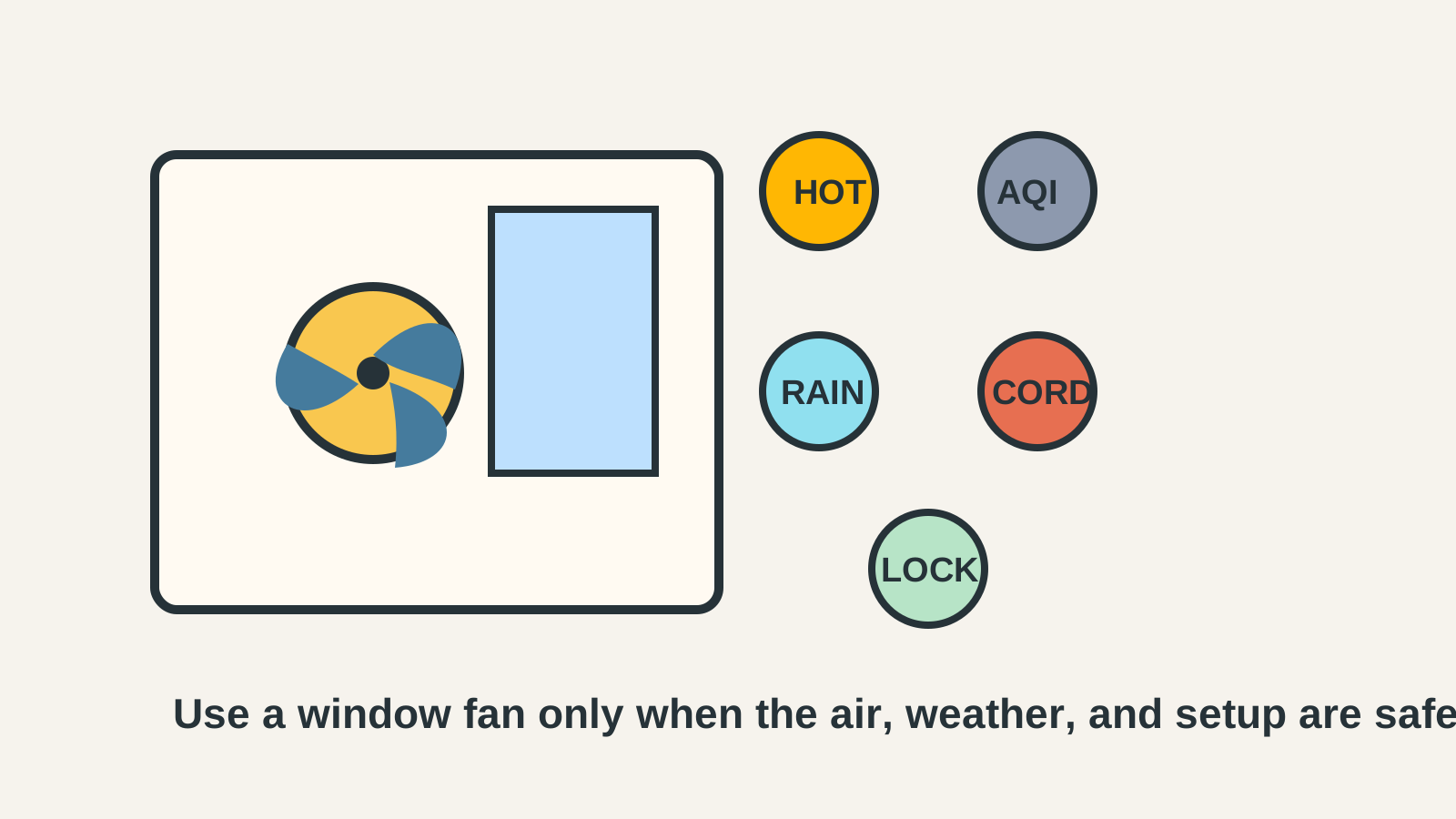
A purifier is a particle vacuum for the air, not a cure for the room. The EPA is clear that no air cleaner will eliminate all pollutants, and that these devices do not address the source of a problem. They will not fix the damp that grows mould, only catch some of the spores it releases. They do not bring in fresh air or remove carbon dioxide, so they are not ventilation. During a wildfire smoke event, the guidance is to keep windows and doors closed and run the purifier on its highest practical setting, because the machine cleans the air you already have rather than the smoke outside. When and how to keep windows shut during smoke, and the wider safety picture, is covered in when not to use a window fan.
One category to avoid outright: any device that intentionally produces ozone, sometimes sold as an ioniser or ozone generator. The EPA states plainly that no federal agency has approved these for use in occupied spaces, and ozone is a lung irritant. A purifier should clean your air without adding a new pollutant to it.
Filter replacement and the real running cost
The purchase price is only the start. Every filter has a working life, and a clogged filter does not just underperform, it strangles the airflow the whole CADR depends on. The EPA puts it simply: all filters need regular replacement, and if a filter is dirty and overloaded it will not work well. As a general benchmark, the agency notes manufacturers commonly recommend replacing filters somewhere in the range of every 60 to 90 days, though heavy use, a dusty home, or a serious smoke season will shorten that.
Treat replacement filters as the true cost of ownership. A cheap unit with proprietary, frequently replaced filters can cost more over a couple of years than a pricier machine with longer-lived ones. Carbon stages, where present, are usually the first to exhaust. Before buying, it is worth knowing how often the filters are replaced and what they cost, because that recurring number, not the sticker price, is what you actually live with.
Noise at the settings you will actually use
CADR is measured at a purifier's top speed, and top speed is loud. The honest problem is that a machine you cannot sleep or hold a conversation next to gets turned down, or off, and a purifier that is off has a CADR of zero. This is the strongest practical argument for sizing up. A unit comfortably oversized for the room reaches your target air changes at a middle or low fan setting, where it is quiet enough to leave running continuously. Buying for the room you have at full blast, rather than for the setting you will tolerate at night, is how good machines end up unused.
Seasonal reality, pollen and smoke
The same metric serves two very different seasons. Spring and early summer bring pollen, a relatively large particle that HEPA captures easily, so a unit sized on the standard two-thirds rule, run in the bedroom overnight, makes a real difference for allergy sufferers. Wildfire smoke is the harder season: the dangerous fraction is fine particulate, the smoke CADR is the number that matters, and the sizing target rises to match the room rather than two-thirds of it. A purifier chosen for the smoke case is comfortably equipped for pollen and everyday dust the rest of the year, which is why, if you size for one scenario, you should size for smoke.
The decision, in the end, is not which brand. It is one number matched to one room. Find the smoke CADR, compare it to your floor area, give yourself headroom for ceilings, smoke, and quiet running, and confirm the filter is real HEPA with an honest carbon stage only if you actually need gas control. Do that and the purifier earns its place.
What to buy and where it fits
As an Amazon Associate, House of Agile earns from qualifying purchases. Prices and availability change, so check the current listing before buying.
The brand matters less than the smoke CADR matched to your room. Use these searches as a starting point, then check each listing's CADR, filter type, and replacement filter price against the rules above.
- HEPA purifier for a bedroom (Small room unit). Best for: Pollen and dust in a bedroom or home office, run quietly overnight. In short: look for a smoke CADR of at least two-thirds of the floor area; sized up so it runs on a low setting. Watch out: A box that says HEPA-type or HEPA-style is not a tested HEPA filter. Compare options on Amazon
- Large room HEPA purifier (Living room unit). Best for: Open-plan living areas and smoke season, where the smoke CADR should match the floor area. In short: high CADR, larger footprint, quieter than a small unit working flat out. Watch out: Check the ceiling height assumption; vaulted rooms need more capacity than the floor area suggests. Compare options on Amazon
- Purifier with a heavy carbon stage (Odour and fumes). Best for: Cooking smells, paint fumes, and the gaseous part of smoke, on top of particle filtration. In short: HEPA plus a substantial carbon filter, measured in weight, not a thin mesh. Watch out: A thin carbon wrap does little over time, and carbon stages need replacing first. Compare options on Amazon
- Replacement filters (Running cost). Best for: Keeping the CADR you paid for; a clogged filter strangles airflow. In short: price the filters before you buy the machine. Watch out: Only buy filters listed for your exact model, and avoid any device sold as an ozone generator or ioniser. Compare options on Amazon
This article is independent analysis by House of Agile. It reflects public health and standards guidance and general physics, not professional medical, indoor-air-quality, or purchasing advice. Verify the CADR ratings, filter type, and replacement costs of any specific unit before buying.
Sources
Clean Air Delivery Rate and sizing standards
- Association of Home Appliance Manufacturers (AHAM), Consumer Blog, "Tips for Choosing the Ideal Portable Room Air Cleaner." CADR measures how fast an air cleaner filters dust, pollen, and tobacco smoke; choose a smoke CADR two-thirds of the room area in square feet; for wildfire smoke use a smoke CADR equal to the room area; targets at least 4.8 air changes per hour for the recommended room size; AHAM Verifide units are independently tested to the manufacturer's claims. https://blog.aham.org/tips-for-choosing-the-ideal-portable-room-air-cleaner/
- AHAM Verifide, "Air Filtration Standards." Background on the AHAM Verifide certification programme and CADR testing for portable room air cleaners. https://ahamverifide.org/ahams-air-filtration-standards/
Filters, what they remove, and what they do not
- US Environmental Protection Agency, "Guide to Air Cleaners in the Home." CADR is for particles only; no air cleaner eliminates all pollutants; most filters are designed to filter either particles or gases; gas-phase carbon filters require a large amount of material; plasma, photocatalytic oxidation, and UV light have not been shown effective for gas removal in home units; all filters need regular replacement, commonly every 60 to 90 days; avoid devices that intentionally produce ozone. https://www.epa.gov/indoor-air-quality-iaq/guide-air-cleaners-home
- US Environmental Protection Agency, "What is a HEPA filter?" A true HEPA filter removes at least 99.97 percent of airborne particles at 0.3 microns, the most penetrating particle size, with larger and smaller particles trapped at higher efficiency. https://www.epa.gov/indoor-air-quality-iaq/what-hepa-filter
Wildfire smoke and operation
- US Environmental Protection Agency, Wildfire Smoke Course, "Preparing for Smoke and Heat." For wildfire smoke, choose a portable air cleaner with a HEPA filter and a tobacco smoke CADR at least two-thirds the room area in square feet; ensure the device does not produce ozone. https://www.epa.gov/wildfire-smoke-course/preparing-smoke-and-heat
- US Environmental Protection Agency, "Wildfires and Indoor Air Quality (IAQ)." Use a portable air cleaner to remove fine particles, run it on the highest fan speed where people spend the most time, and keep windows and doors closed during smoke events. https://www.epa.gov/emergencies-iaq/wildfires-and-indoor-air-quality-iaq