Tall Orders: Ranking the Physical Profiles of the 2026 World Cup
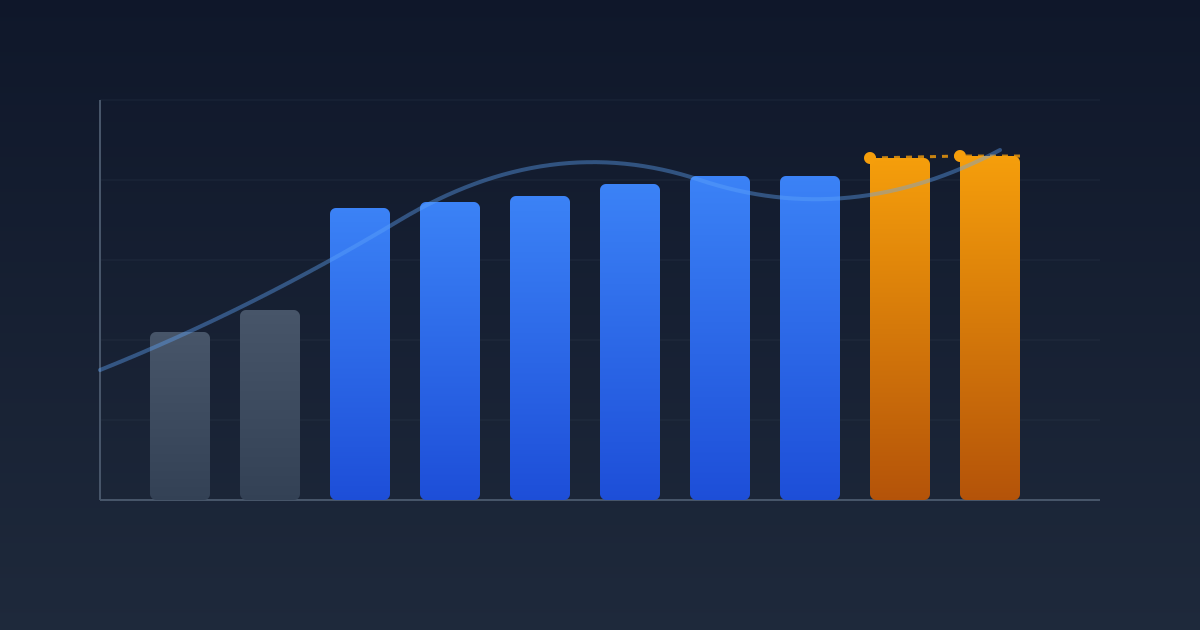
Programmatic extraction from the official 2026 World Cup squad list reveals a height delta of nearly 9cm between tallest and shortest teams.
Football is a game of space, time, and increasingly, centimetres. Using programmatic extraction from the official FIFA World Cup 2026 squad list, we mapped the height distributions across all 48 participating countries. The data reveals a massive physical divide between the tournament's giants and its relative lightweights.
The Height Hierarchy
At the top of the height table, two UEFA nations lead the pack. Bosnia and Herzegovina (187.1 cm average) and Norway (187.2 cm average) represent the absolute peak of physical stature in international football. Close behind are Germany (186.2 cm) and Sweden (186.2 cm), signaling a distinct European trend toward physical size, complemented by West African powerhouse Senegal.
On the other side of the spectrum, squads like Mexico (179.5 cm) and Saudi Arabia (178.4 cm) average nearly a full 9 centimetres shorter per player.
Here is a look at key height averages and their statistical characteristics:
Norway (NOR): Average Height: 187.2 cm | Height Std Dev: 6.38 cm | Archetype: Towering Spine / Dual Target Men Germany (GER): Average Height: 186.2 cm | Height Std Dev: 6.38 cm | Archetype: Athletic Zonal / Physical Pressing Netherlands (NED): Average Height: 185.2 cm | Height Std Dev: 7.38 cm | Archetype: Hybrid / Ball-Playing Giants Mexico (MEX): Average Height: 179.5 cm | Height Std Dev: 6.07 cm | Archetype: Low Gravity / Agile Pressing * Saudi Arabia (KSA): Average Height: 178.4 cm | Height Std Dev: 6.01 cm | Archetype: Technical / Low-Block Compactness
The "PAI" (Physical Advantage Index)
To translate this raw data into predictive power, analysts have developed the Physical Advantage Index (PAI). The PAI doesn't just look at team averages; it weights key matchups - specifically, the height of a team's attacking aerial unit (strikers and target center-backs) against the opposing team's starting central defenders.
When Norway faced Mexico, the PAI predicted a massive mismatch. With Norway's key aerial unit (Haaland, Sørloth, Ajer, Østigård) averaging over 191 cm, and Mexico's central defenders averaging just under 182 cm, the resulting PAI predicted a "Strong Physical Advantage." The outcome bore this out: Norway's set-piece expected goals (xG) surged, exploiting the physical delta.
However, the index also highlights "Balanced" matchups. Against Ivory Coast (boasting Ndicka at 192 cm and Kossounou at 191 cm) or Brazil (Gabriel Magalhães at 190 cm), Norway's height advantage evaporated. In these fixtures, the physical mismatch is neutralized, forcing teams to rely purely on tactical choreography rather than raw size.
This article is independent analysis by House of Agile. It reflects public sources and the author's own experience, not financial or legal advice.