Why Are There Five WeWorks In Warsaw And None In Lyon?
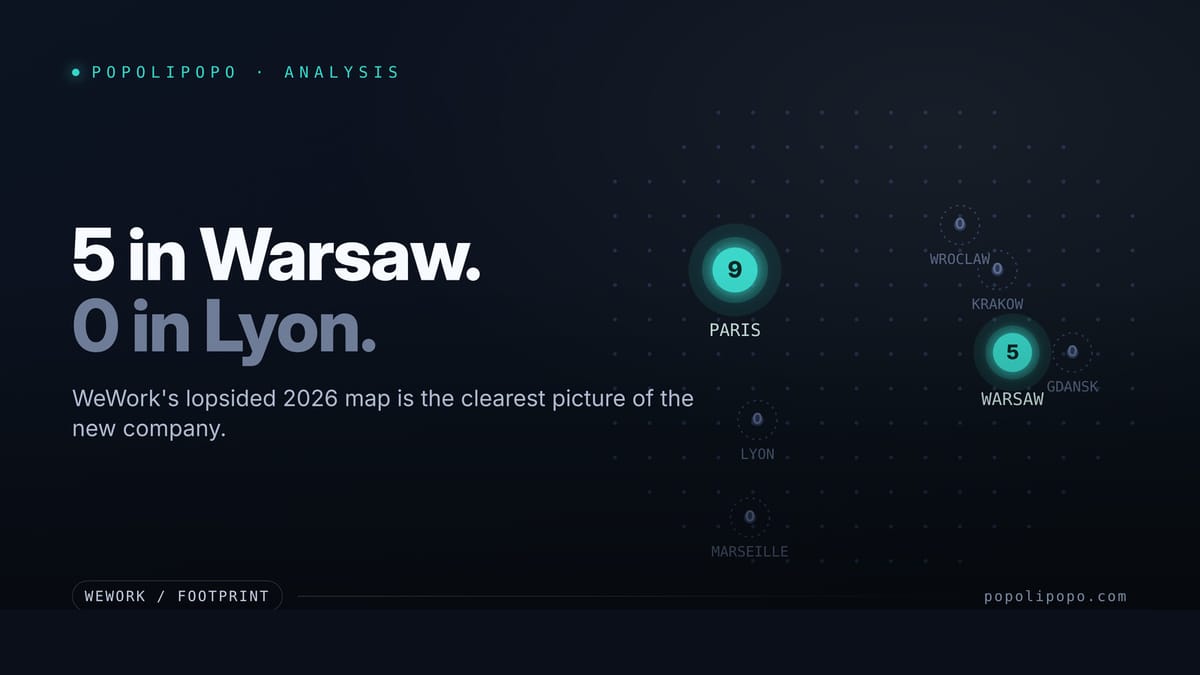
WeWork has five locations in Warsaw and nine in Paris but none in Lyon, Marseille, Krakow or Wroclaw. The odd map is the clearest picture of the new company.
WeWork's post-bankruptcy map is selective, concentrated, and surprisingly revealing. Paris gets nine locations. Warsaw gets five. Lyon, Marseille, Krakow, and Wroclaw get zero. The pattern is not about which cities are cool. It is about which cities can carry WeWork economics.
The strangest thing about WeWork in 2026 is not that it still exists. (It does, as a leaner private company that emerged from bankruptcy in 2024.) The strangest thing is the map.
Open the official locations list and the company looks global again: around 599 open and coming-soon locations across 125 cities. Then zoom into Europe and the picture gets genuinely weird. France is Paris only. Poland is Warsaw only. Italy is Milan. Portugal is Lisbon. The Netherlands is Amsterdam. Spain gets Barcelona and Madrid. Germany spreads across Berlin, Cologne, Frankfurt, Hamburg, and Munich. The United Kingdom is heavily London-weighted but also reaches Manchester, Cambridge, and Edinburgh.
So why five WeWorks in Warsaw and not one in Krakow, Wroclaw, Gdansk, or Poznan? Why nine in Paris and nothing in Lyon or Marseille? It is not because those cities lack coworking demand. It is because the new WeWork measures cities by a different yardstick than the old one did.
WeWork's European map in 2026
Here is the official footprint as listed on WeWork's own country and city pages, checked in late May 2026:
- France: 9 locations, all in Paris. No Lyon, no Marseille.
- Poland: 5 locations, all in Warsaw. No Krakow, Wroclaw, Gdansk, Poznan, Katowice, or Lodz.
- Germany: roughly 13 locations across Berlin, Cologne, Frankfurt, Hamburg, and Munich.
- United Kingdom: around 31 locations, London-dominant, plus Manchester, Cambridge, and Edinburgh.
- Spain: Barcelona and Madrid.
- Italy, Portugal, Netherlands: one city each (Milan, Lisbon, Amsterdam).
This is not the old WeWork map, the one that planted flags in every second-tier startup city as fast as capital allowed. This is the post-bankruptcy map, drawn by a company that now treats every fixed lease as a risk it has already been burned by once.
The growth pattern after bankruptcy
To read the map, you have to read how the new WeWork actually expands.
Since emerging from Chapter 11 in June 2024, WeWork's announced moves have been concentrated and defensive: a redesigned coworking space in Miami, new and replacement Manhattan locations at 250 Broadway, 245 Fifth Avenue, and 511 Fifth Avenue, added square footage in Toronto and North Dallas, the smaller WeWork Go pod product, and a large third-party Coworking Partner Network that now spans roughly 2,000 locations.
The pattern is consistent. The growth is not "open a WeWork wherever there is startup energy." It is "add space where demand is already proven, replace old leases with better economics, and use partners where carrying a direct lease does not make sense." If you accept that logic, the lopsided map stops looking random. It starts looking like a series of risk decisions.
That logic explains Warsaw. It also explains the empty spaces around it.
Warsaw is not Poland. It is the Polish enterprise gateway.
WeWork lists five Warsaw locations: Grzybowska 60, Hotel Europejski, Mennica Towers, Grzybowska 62, and Krucza 50. They cluster around the central business districts, especially Wola and Srodmiescie.
That does not mean Krakow, Wroclaw, Gdansk, Poznan, Katowice, or Lodz lack coworking demand. They do not. Poland's regional flex-office market is genuinely active, and flexible workspace has grown past 3 percent of the country's office stock according to market trackers. But regional demand existing is not the same as WeWork-grade demand existing.
Warsaw gives WeWork a dense stack of exactly what its product is built to sell: international firms, finance, consultancies, embassies, regional headquarters for central and eastern Europe, enterprise teams, and business travelers who already recognize the brand. It is the deepest corporate office market in the country and the regional headquarters hub for the wider CEE region. A premium, English-speaking, enterprise-oriented coworking brand can charge premium prices there in a way it cannot easily do in a smaller regional market served by leaner local operators.
Five in one city beats one in five cities
There is a second, less obvious reason the clustering makes sense, and it is about the product, not just the city.
WeWork's All Access and On Demand products sell access to a network, not a single seat. The value of that promise scales with density. Five buildings in Warsaw means a member, a visitor, or an enterprise team can move between locations, find a free desk near a meeting, or absorb a busy day by walking to the next site. One isolated building in Wroclaw would just be a location. Five in Warsaw is a network.
So the choice is not really "Warsaw versus Krakow." It is "deepen a working network in the one city that can support it" versus "scatter single, fragile outposts across cities that cannot." After bankruptcy, the first option is obviously safer.
Why coworking demand is not the same as WeWork economics
France makes the same point even more sharply.
There is serious flex-office demand outside Paris. Coworking and flex space accounted for a large and growing share of French office transactions in 2025, with Lyon, Bordeaux, Toulouse, and Marseille all showing up as growth markets in industry reports. And yet WeWork's official France footprint is nine locations, every one of them in Paris.
The reason is the gap between "this city has coworking demand" and "this city can carry the WeWork cost structure." A local operator in Marseille can run a leaner product, lower rent, lighter staffing, and price accordingly. WeWork has to justify its brand, its expensive fit-out, its operations, its app, its support, and its enterprise sales machine. If a regional city cannot support premium pricing, or if a landlord will not share enough of the lease risk, the new WeWork can simply decline to go there and let the Coworking Partner Network cover it instead.
Paris, by contrast, concentrates national headquarters, global firms, investors, media, events, tourists, and startup density, and it is where WeWork already had staff, brand awareness, members, and lease history before the restructuring. It clears the bar. Lyon and Marseille may be excellent coworking cities. That does not automatically make them good WeWork cities in 2026.
Why the lounges feel half empty
This same logic explains a complaint a lot of visitors share, including ours: you walk into a big-city WeWork, often on a borrowed pass, and it feels oddly quiet.
The company is not necessarily trying to fill every visible chair every hour of every day. It sells private offices, enterprise flexibility, meeting rooms, day passes, and network access. A lounge that looks sleepy at 11 in the morning on a Friday can sit inside a building whose private offices are fully leased, whose meeting rooms peak on Tuesday and Wednesday, and whose rent was renegotiated downward in bankruptcy so that lower visible occupancy is survivable.
Reddit shows both sides, and it is worth treating as anecdote rather than measured occupancy: some users describe empty floors and silent weekends, others complain that specific New York locations are overcrowded. That contradiction is the business. Demand is spiky, local, and tied to specific buildings, days, and product tiers. The "empty" feeling is often off-peak optionality, not a dying location. We follow the most visible version of that, access bundled into a fintech subscription, in Revolut Ultra Turned WeWork Into A Work Lounge.
The map is a balance sheet with memory
Put it all together and the odd map stops being a mystery.
Five Warsaw sites and none elsewhere in Poland. Nine Paris sites and none in Lyon or Marseille. Multiple German cities. A London-heavy United Kingdom. This is not an urban-planning judgment about which cities deserve good coworking. It is a balance-sheet judgment about which cities can carry WeWork's cost structure at premium prices with acceptable lease risk.
The old WeWork pretended this could become a universal tech platform that belonged everywhere. The new WeWork behaves like a real estate company with memory. It knows exactly which cities, and which leases, hurt it last time, and it is drawing the map accordingly. For the full story of how the company got here, see WeWork Collapsed. WeWork Did Not Disappear..
WeWork's European footprint: quick answers
How many WeWork locations are there in Poland?
WeWork's official pages list five locations in Poland, all in Warsaw, with none currently listed in Krakow, Wroclaw, Gdansk, Poznan, Katowice, or Lodz as of May 2026.
How many WeWork locations are there in France?
WeWork lists nine locations in France, all in Paris. There is no official WeWork city page for Lyon or Marseille.
Why is there no WeWork in Lyon or Marseille?
Not because those cities lack coworking demand. The likeliest reason is that WeWork's premium cost structure and post-bankruptcy caution make new regional leases hard to justify, while local operators and WeWork's partner network can cover the demand instead.
Are WeWork offices closing?
The concentrated map is mostly the result of bankruptcy-era lease decisions, not a fresh wave of closures. WeWork is even adding selectively in proven markets. Some legacy sites did close during restructuring, but the company is not in liquidation.
Related reading
This is independent analysis from popolipopo. Location counts and city availability were checked against WeWork's official country and city pages on May 29, 2026, and we separate that official footprint data from our own market interpretation. Reddit and user observations are treated as anecdote, not measured building occupancy. Nothing here is investment advice.
Sources and Method
Location counts and city availability were checked against official WeWork location pages on 2026-05-29. The analysis distinguishes official footprint data from market interpretation.
- WeWork global locations
- WeWork Warsaw
- WeWork Poland
- WeWork France
- WeWork Germany
- WeWork United Kingdom
- WeWork Miami Southeast Financial Center
- WeWork 250 Broadway lease
- WeWork 245 Fifth Avenue lease
- WeWork Toronto expansion
- WeWork Dallas expansion
- Commercial Observer: 511 Fifth Avenue
- WeWork Coworking Partner Network expansion
- Coworking Europe: French flex office market
- Allwork: Poland flexible workspace market