Where to Put a Window Fan So It Actually Moves Air
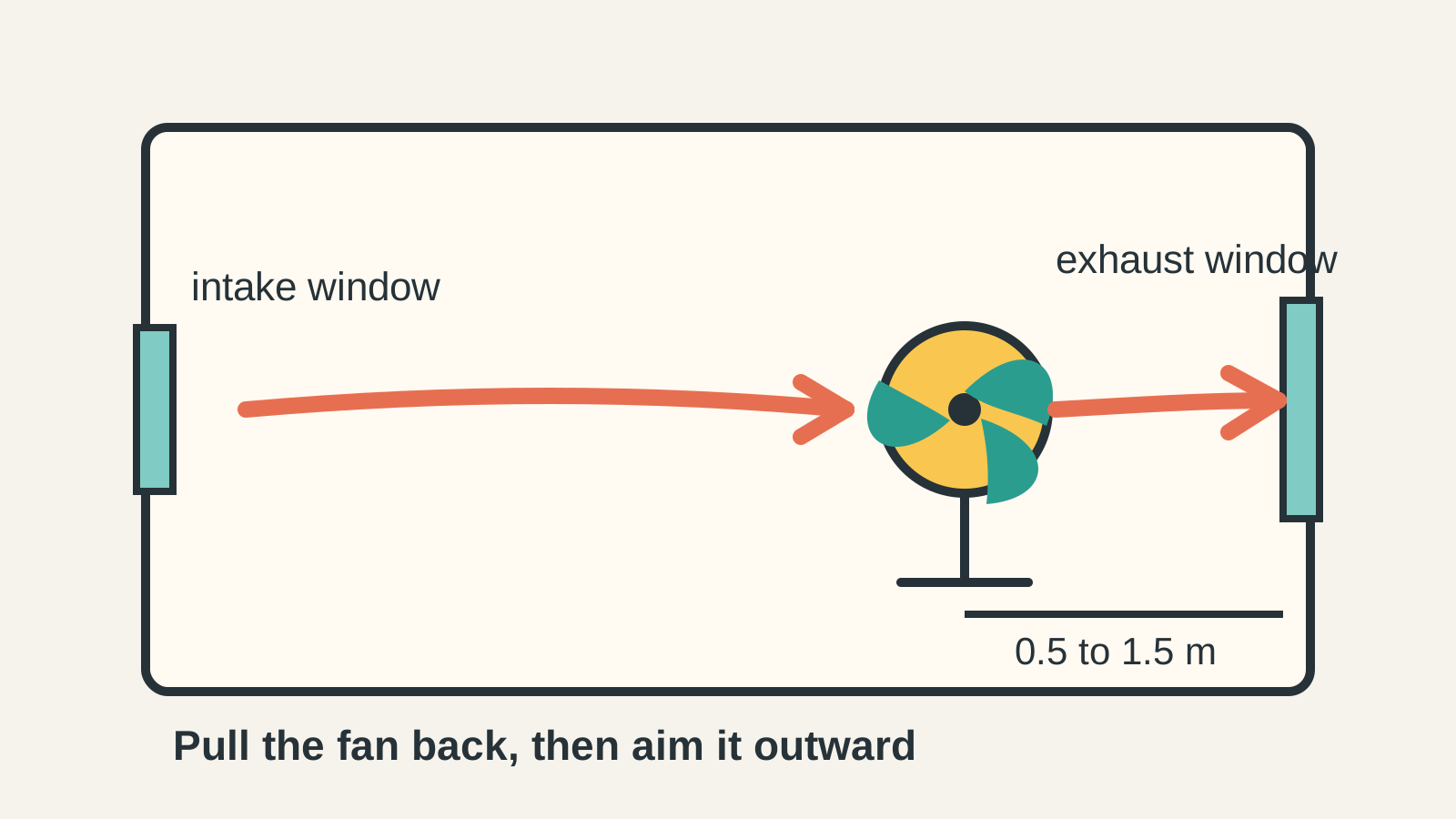
For whole-house airflow, use the fan as an exhaust, pull it at least 0.5 m inside, and test the setup with another window open as intake.
Most people put a fan directly in the window. It feels obvious: the opening is there, the fan fits, and the goal is to move air through the opening.
A measured home experiment points to a better default. If you want to move air through a room or house, the fan often works better when it is pulled back from the screen, aimed outward, and paired with another open window as an intake.
The practical starting setup is simple:
- Point the fan outward, blowing indoor air out of the window.
- Put the fan at least 0.5 m / 2 ft inside the room.
- If you have space, test 1.0 to 1.5 m / 3 to 5 ft from the window.
- Aim the strongest part of the air stream through the opening.
- Open another window or door elsewhere so replacement air can enter.
That last detail matters. A fan cannot move much air through a house if the house has no easy intake path.
Why pulling the fan back can work better
A fan does not push a perfect cylinder of air. It creates a jet. As that jet travels, it entrains surrounding room air, which means it drags additional air along with it.
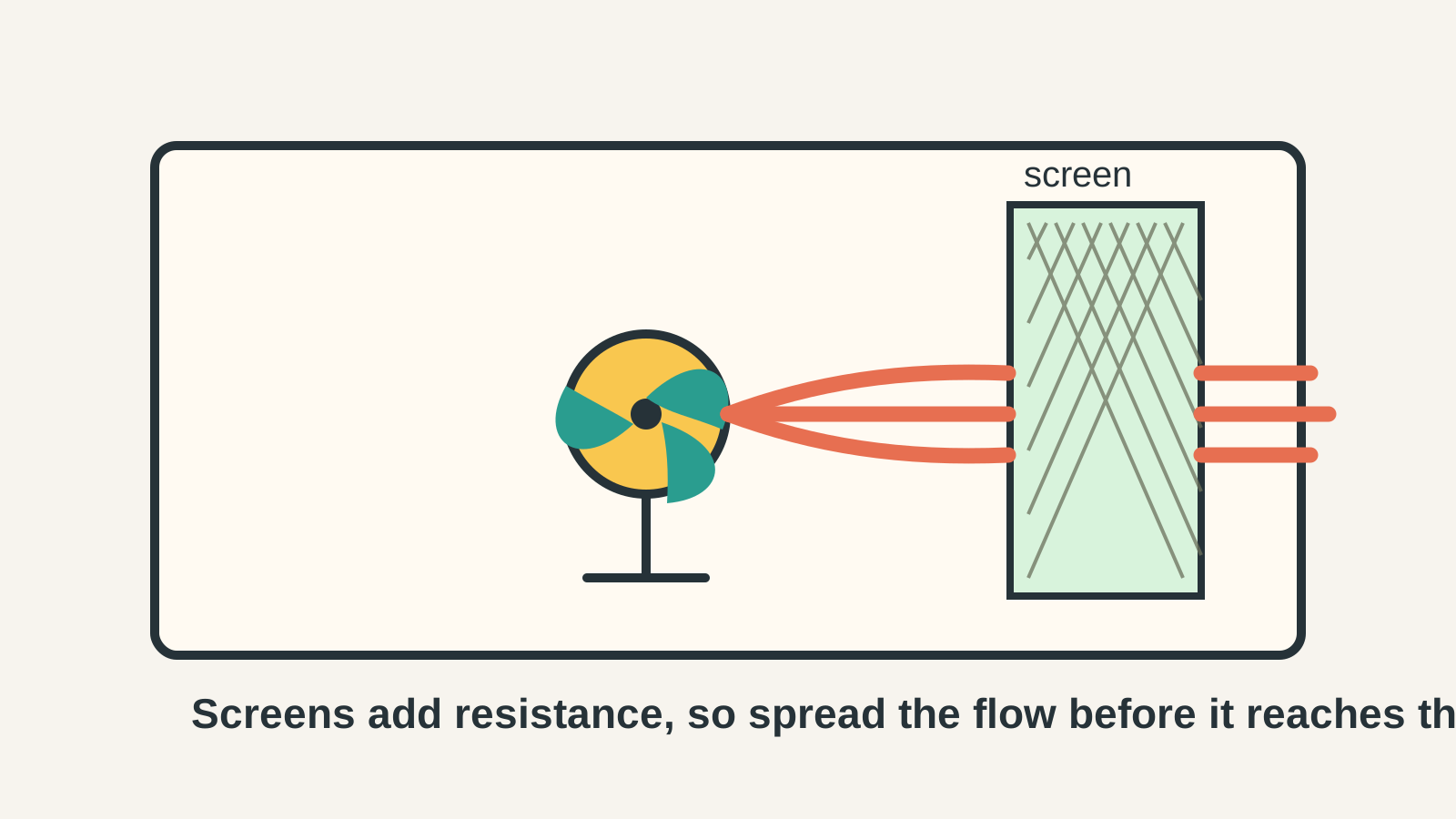
When the fan is pressed directly against a screened window, the jet has almost no room to develop. The flow around the edges can also recirculate near the screen, so some air is churned around the window instead of being pulled from deeper inside the room. Ventilation guides call this kind of problem short-circuiting: air takes the easy local path instead of crossing the space you are trying to ventilate.
Pulling the fan back gives the intake and outlet flow room to form. The fan can collect more room air, the jet can spread, and more of the window opening can become useful exhaust area.
The best distance is a range, not a magic number
The transcript experiment found a clear improvement when the fan moved from flush against the screen to about 0.5 m away. Distances farther back, including around 1.5 m and up to roughly 2.1 m in that setup, performed similarly, with only small differences.
So do not treat 1.5 m as a universal optimum. Treat it as a practical target when the room has space and the fan can still be aimed cleanly.
Use this rule of thumb:
- Good starting point: about 0.5 m / 2 ft inside the room.
- Practical test range: about 0.5 to 1.5 m / 2 to 5 ft.
- Fine-tuning: aim matters more than exact distance once the fan is pulled back.
- Diminishing returns: beyond that range, gains may be small unless your room geometry favors it.
If the fan is far enough back but the air stream hits the window frame or wall, move it closer or change the angle. The setup only works if the jet actually exits.
Blowing out is usually the right whole-house default
For local comfort, pointing a fan inward at your body can feel good. That is not the same job as ventilating a house.
For whole-room or whole-house airflow, the more robust pattern is exhaust plus intake. Put the fan at one window blowing outward. Open another window elsewhere, ideally on the cooler or shaded side. The fan removes warm indoor air, and outside air replaces it through the intake.
This is the same basic logic behind whole-house fans and exhaust ventilation: do not put the exhaust right beside the replacement-air source, and do not let the air loop locally around the fan.
There are exceptions. A strong breeze may already be pushing air through the best window. A single-room setup may only need a fan pointed inward for skin cooling. But if the goal is to flush warm air through the home at night, start with the fan as an exhaust.
Screens can be the bottleneck
The screen is not neutral. Insect screens add resistance, and technical studies show that pressure drop rises as air speed through the screen rises. That means a fan pressed tightly against one small part of a screen can waste energy pushing a fast, uneven patch of air through a restrictive mesh.
You do not always need to remove the screen, and in many homes you should not. But you should know what it is doing:
- A fine screen can reduce airflow noticeably.
- Dusty screens make the restriction worse.
- Heavy curtains close to the window can block or deflect the jet.
- A wider, clearer opening gives the fan a better chance.
If airflow still feels weak after moving the fan back, clean the screen, clear the curtain path, and test a wider opening before blaming the fan.
A quick test at home
You do not need an anemometer. Use a strip of tissue, a light curtain, incense smoke, or your hand at the intake window.
Try three placements:
- Fan directly in or against the window.
- Fan about 0.5 m / 2 ft inside.
- Fan about 1.5 m / 5 ft inside.
Keep the fan speed, fan direction, and open windows the same. Give the room a minute between changes. If the intake window pulls harder when the fan is back from the window, the setup is working.
The best placement is the one that moves air through the house, not the one that looks most attached to the window.
Quick answers
Should a fan face in or out of a window? For whole-house airflow, start with the fan facing out. Use another open window as the intake.
How far from the window should the fan be? Start around 0.5 m / 2 ft inside the room. Test 0.5 to 1.5 m / 2 to 5 ft and keep the position that creates the strongest intake airflow elsewhere.
Is 1.5 m always the best fan distance? No. One experiment saw strong readings around 1.5 m, but most of the gain appeared after moving the fan back by about 0.5 m.
Does a sealed window fan change the advice? Yes, partly. A purpose-built window fan or a box fan with a good shroud can reduce recirculation when mounted in the opening. A loose bare fan against a screen is more likely to waste flow.
Related reading:
- Box Fan vs Desk Fan: When Smart Placement Beats Size
- How Much Do Window Screens Reduce Fan Airflow?
- How to Cool a House at Night With One Fan and Two Windows
- When Not to Use a Window Fan: Heat, Smoke, and Safety
What to buy and where it fits
As an Amazon Associate, House of Agile earns from qualifying purchases. Prices and availability change, so check the current listing before buying.
The right fan depends on the job. For pushing air through a window or across a whole room, raw airflow wins. For cooling one person at a desk, a small quiet fan is plenty. Here is how the main types compare for the airflow goals in this article.
- 20-inch box fan (Box fan). Best for: Moving the most air through an open window or across a whole room on a budget. In short: airflow high; noise moderate to high at top speed; large, sits in or just back from the window. Watch out: Pull it about 0.5 m back from the screen so it does not short-circuit its own airflow. Compare options on Amazon
- High-velocity floor fan (Floor fan). Best for: Maximum throw across a large or long room when you need to push air a long way. In short: airflow very high; noise high; compact metal cage, tilts to aim. Watch out: Loud; better for daytime or garages than a quiet bedroom. Compare options on Amazon
- Air circulator (Air circulator). Best for: Mixing and circulating air in a room that has no usable window airflow. In short: airflow medium, focused stream; noise low to moderate; small, sits on the floor or a shelf. Watch out: Circulates room air rather than exhausting it; pair with an open window for fresh air. Compare options on Amazon
- Desk or personal fan (Desk fan). Best for: Targeted personal cooling at a desk or bedside, where you do not need whole-room flow. In short: airflow low to medium, but effective up close; noise low; very small. Watch out: Will not cool a room; it cools the person in front of it. Compare options on Amazon
- Tower fan (Tower fan). Best for: Oscillating coverage in a tight space when floor footprint and quiet matter. In short: airflow medium; noise low; tall and narrow. Watch out: Lower raw airflow than a box or floor fan; favor it for comfort, not for window exhaust. Compare options on Amazon
This article is independent practical analysis by House of Agile. It reflects a supplied experiment transcript, public sources, and general airflow reasoning, not professional HVAC, electrical, or heat-safety advice.
Sources
Primary source
- Matthias Wandel, fan placement experiment video, accessed 2026-06-26. https://www.youtube.com/watch?v=1L2ef1CP-yw
Supporting sources
- FSSHining, consumer summary of the same fan placement experiment, accessed 2026-06-26. https://www.fsshining.com/news/where-is-the-best-fan-placement-to-make-the-room-cooler
- TLC Direct, extract fan siting and short-circuiting guidance, accessed 2026-06-26. https://www.tlc-direct.co.uk/Technical/Ventilation/WhereVent.htm
- Building America Solution Center, whole-house fan guidance, accessed 2026-06-26. https://basc.pnnl.gov/resource-guides/whole-house-fans
- U.S. Department of Energy, natural ventilation guidance, accessed 2026-06-26. https://www.energy.gov/energysaver/natural-ventilation
- Positive pressure fan placement explainer video, used as an analogy for backing fans away from openings, accessed 2026-06-26. https://www.youtube.com/watch?v=YUOQad6esE4
- Window screen CFD study, accessed 2026-06-26. https://pmc.ncbi.nlm.nih.gov/articles/PMC11168052/
Method note
This article combines one measured home experiment with broader ventilation principles. The exact best distance depends on fan, screen, window, room geometry, and outdoor wind, so the article recommends a test range rather than a universal optimum.